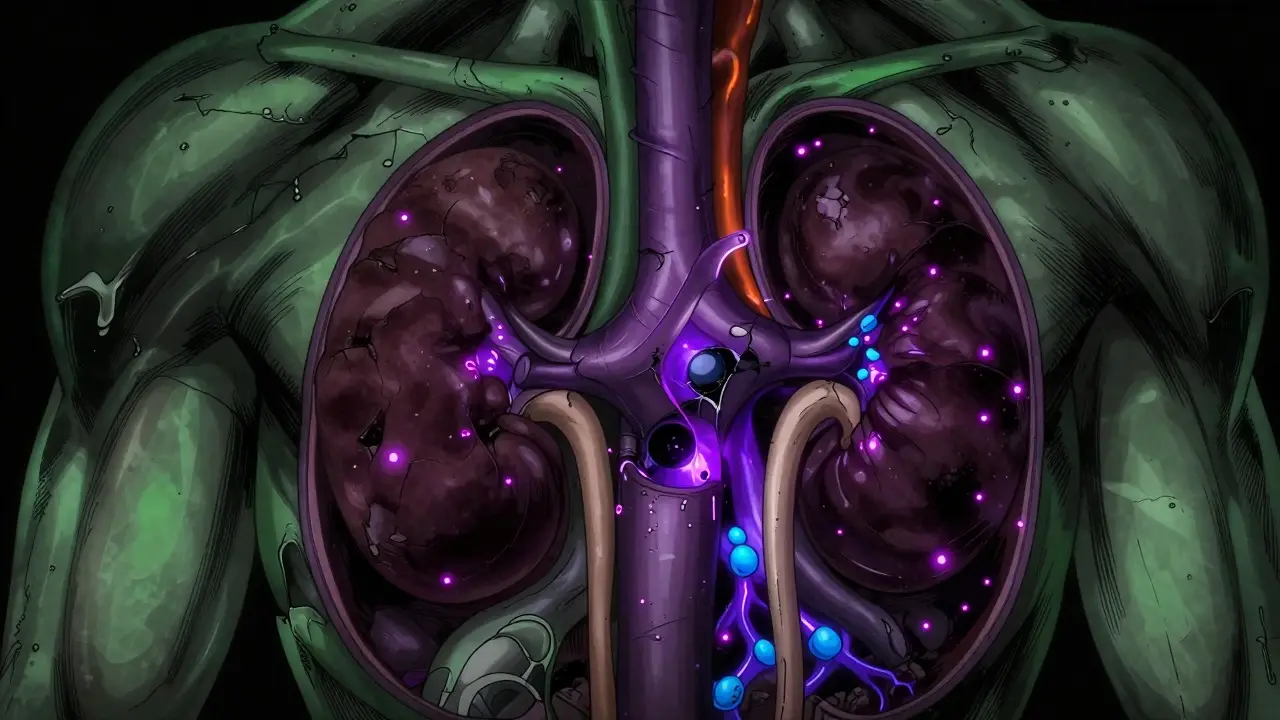
When your kidneys start to fail, the damage doesn't stop at filtering waste. It quietly reshapes your skeleton and stiffens your arteries. This condition, known as Chronic Kidney Disease-Mineral and Bone Disorder (CKD-MBD), is a systemic syndrome affecting up to 90% of patients with Stage 3-5 CKD. It’s not just about low bone density; it’s a complex interplay between calcium, phosphorus, parathyroid hormone (PTH), and vitamin D that drives both fracture risk and cardiovascular death.
Many patients focus solely on dialysis schedules or blood pressure, missing the fact that mineral imbalance is a primary driver of mortality in late-stage kidney disease. Understanding how these four elements interact is crucial for anyone managing advanced CKD or caring for someone who is. The goal isn't just to keep numbers in range, but to break the cycle of bone breakdown and vascular calcification before it becomes irreversible.
The Core Problem: A Broken Feedback Loop
To understand CKD-MBD, you have to look at how healthy kidneys handle minerals. Normally, kidneys excrete excess phosphorus and activate vitamin D into its usable form, calcitriol. When Glomerular Filtration Rate (GFR) drops below 60 mL/min/1.73m², this system stalls. Phosphorus builds up in the blood because the kidneys can't filter it out efficiently. Simultaneously, the production of active vitamin D plummets by 50-80% in later stages.
This creates a domino effect. High phosphorus binds to calcium in the blood, lowering free calcium levels. The body senses this drop and screams for more calcium. The parathyroid glands respond by pumping out massive amounts of Parathyroid Hormone (PTH). In a healthy person, high PTH would pull calcium from bones to raise blood levels. In CKD, however, the bones often become resistant to PTH signals due to uremic toxins. So, the PTH stays elevated-often exceeding 300 pg/mL in dialysis patients-but the bones don't respond as expected. This state is called secondary hyperparathyroidism, and it's the engine driving much of the bone loss seen in CKD.
Why Vitamin D Is More Than a Supplement
Vitamin D plays two distinct roles in this equation, and confusing them leads to ineffective treatment. First, there is nutritional vitamin D (25-hydroxyvitamin D), which acts like a pro-hormone. Deficiency here affects 80-90% of CKD patients and is linked to a 30% higher mortality risk. Second, there is active vitamin D (calcitriol), which directly tells the gut to absorb calcium and tells the parathyroid glands to shut down PTH production.
Historically, doctors relied heavily on active analogs like calcitriol to control PTH. However, recent data suggests that simply correcting nutritional vitamin D deficiency reduces overall mortality without increasing the risk of hypercalcemia. For most patients in Stages 3-4, supplementing cholecalciferol (Vitamin D3) to maintain levels above 30 ng/mL is the first line of defense. Active analogs are reserved for severe cases where PTH remains stubbornly high despite other interventions, usually when PTH exceeds 500 pg/mL.
Managing Phosphate: The Hidden Driver
If calcium and PTH are the visible symptoms, phosphate is often the hidden trigger. As kidney function declines, serum phosphate levels rise, typically exceeding 4.5 mg/dL in Stage 3-5 patients. Every 1 mg/dL increase in serum phosphate corresponds to an 18% increased mortality risk. High phosphate doesn't just lower calcium; it promotes vascular calcification, turning arteries into rigid pipes that struggle to handle blood pressure changes.
Controlling phosphate requires a three-pronged approach:
- Dietary Restriction: Aiming for 800-1000 mg of phosphate per day. This is harder than it sounds because phosphate is added to many processed foods as a preservative. Reading labels for "phosphate" or "polyphosphate" is essential.
- Phosphate Binders: These medications take phosphate out of the gut during meals. Calcium-based binders are common but must be limited to 1500 mg of elemental calcium per day to avoid adding too much calcium to the bloodstream, which accelerates vascular calcification. Non-calcium options like sevelamer hydrochloride or lanthanum carbonate are alternatives for those at high risk of vascular issues.
- Dialysis Optimization: Longer sessions (4-5 hours) three times a week remove more phosphate than standard short sessions.

Treatment Strategies: From Binders to Calcimimetics
Treating CKD-MBD isn't one-size-fits-all. The strategy depends on where the patient stands in the CKD progression and their specific lab values. KDIGO guidelines emphasize integrated management rather than treating each number in isolation.
| Intervention | Primary Target | Key Considerations | Typical Use Case |
|---|---|---|---|
| Nutritional Vitamin D (D3) | 25(OH)D Levels | Safe, reduces mortality risk, no direct effect on PTH if normal | Baseline deficiency in Stage 3-5 CKD |
| Calcium-Based Binders | Serum Phosphate | Risk of hypercalcemia and vascular calcification if overused | Mild hyperphosphatemia with low-normal calcium |
| Active Vitamin D Analogs | PTH Suppression | Can raise calcium and phosphate; use cautiously | Severe secondary hyperparathyroidism (PTH >500 pg/mL) |
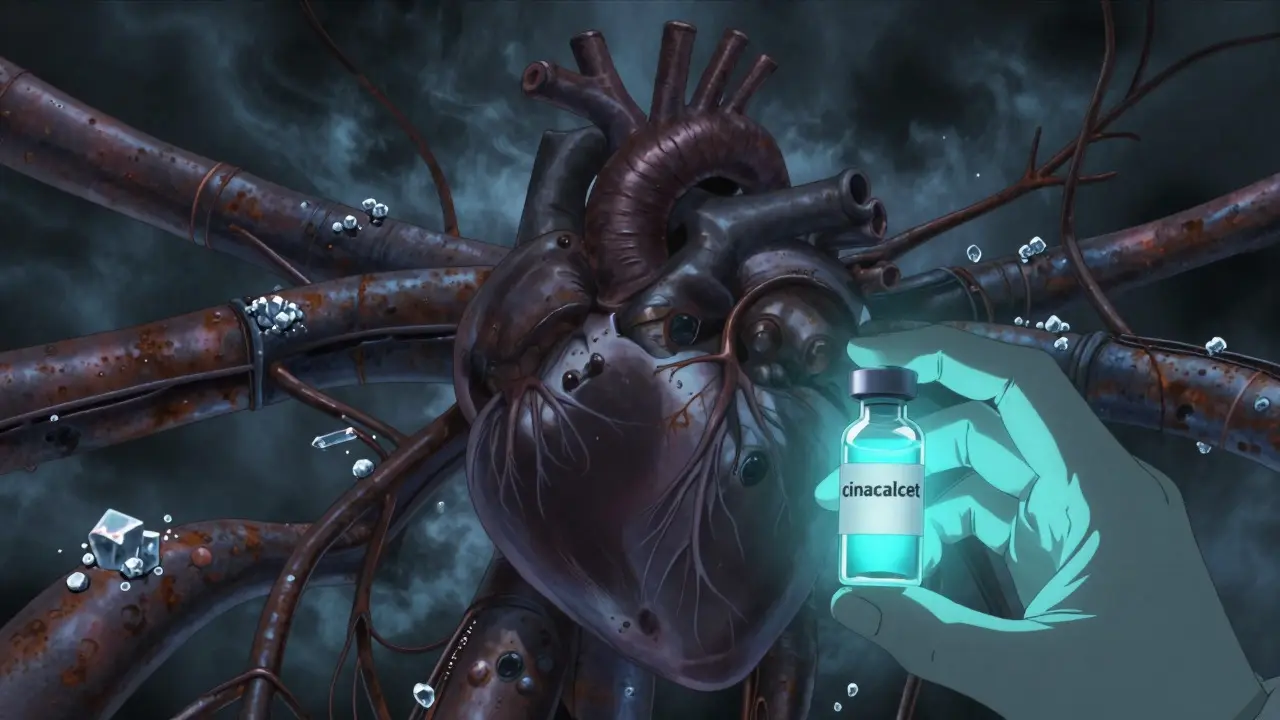
| Calcimimetics (e.g., Cinacalcet) | PTH Sensitivity | Lowers PTH without raising calcium-phosphate product | Refractory hyperparathyroidism, especially in dialysis |
The Vascular Connection: Why Arteries Matter
We often talk about bones in CKD-MBD, but the heart and vessels are equally at risk. Vascular calcification is present in 75-90% of dialysis patients. It progresses rapidly, advancing 15-20% per year. This calcification makes arteries stiff, leading to hypertension and left ventricular hypertrophy. Coronary artery calcification scores in dialysis patients are 3-5 times higher than in the general population. The link between bone and vessel pathology is shared through the FGF23-Klotho axis. Fibroblast Growth Factor 23 (FGF23) rises dramatically in early CKD to help excrete phosphate. However, without enough Klotho protein (which decreases by 50-70% in Stage 3-4 CKD), FGF23 starts causing harm, contributing to cardiac thickening. Sclerostin, another protein, also increases in CKD, inhibiting bone formation pathways. This dual hit-impaired bone building and accelerated vascular hardening-explains why CKD patients face such high rates of both fractures and heart attacks.
Monitoring and Diagnostic Targets
Effective management requires regular monitoring. You aren't just checking blood pressure; you're tracking a constellation of markers. Here are the key targets based on current KDIGO guidelines:
- Serum Calcium: Aim for 8.4-10.2 mg/dL. Avoid both hypocalcemia and hypercalcemia.
- Serum Phosphate: Target 2.7-4.6 mg/dL for non-dialysis CKD 3-5, and 3.5-5.5 mg/dL for dialysis patients.
- Intact PTH: There is no single "normal" value. Targets are generally 2-9 times the upper limit of normal for the specific assay used. For example, if the lab's upper limit is 65 pg/mL, the target range might be 130-585 pg/mL depending on the stage of CKD.
- 25-Hydroxyvitamin D: Maintain levels above 30 ng/mL to prevent deficiency-related complications.
Frequently Asked Questions
What is the difference between primary and secondary hyperparathyroidism in CKD?
Primary hyperparathyroidism is caused by a tumor or overactive gland producing too much PTH independently of kidney function. Secondary hyperparathyroidism in CKD is a compensatory response to low calcium and high phosphate caused by kidney failure. The goal in CKD is to manage the underlying mineral imbalances to reduce the drive for excessive PTH production.
Should I take Vitamin D supplements if I have CKD?
Yes, but the type matters. Most CKD patients need nutritional Vitamin D3 (cholecalciferol) to correct deficiency and maintain levels above 30 ng/mL. Active forms like calcitriol are prescription-only and should only be used under doctor supervision for severe PTH elevation, as they can cause dangerous spikes in calcium and phosphate if misused.
How does high phosphate affect my heart?
High phosphate promotes the deposition of calcium in blood vessel walls, a process called vascular calcification. This stiffens the arteries, making it harder for the heart to pump blood efficiently. Over time, this contributes to hypertension, heart failure, and increased risk of heart attack and stroke.
Are calcium-based phosphate binders safe for everyone?
Not necessarily. While effective, they add extra calcium to the body. If your calcium or calcium-phosphate product is already high, or if you have significant vascular calcification, doctors may prefer non-calcium binders like sevelamer or lanthanum to minimize the risk of further arterial stiffening.
When is cinacalcet recommended?
Cinacalcet is typically recommended for patients with severe secondary hyperparathyroidism, particularly those on dialysis whose PTH levels remain very high (often >800 pg/mL) despite dietary changes and other treatments. It helps lower PTH without significantly increasing calcium or phosphate levels.
