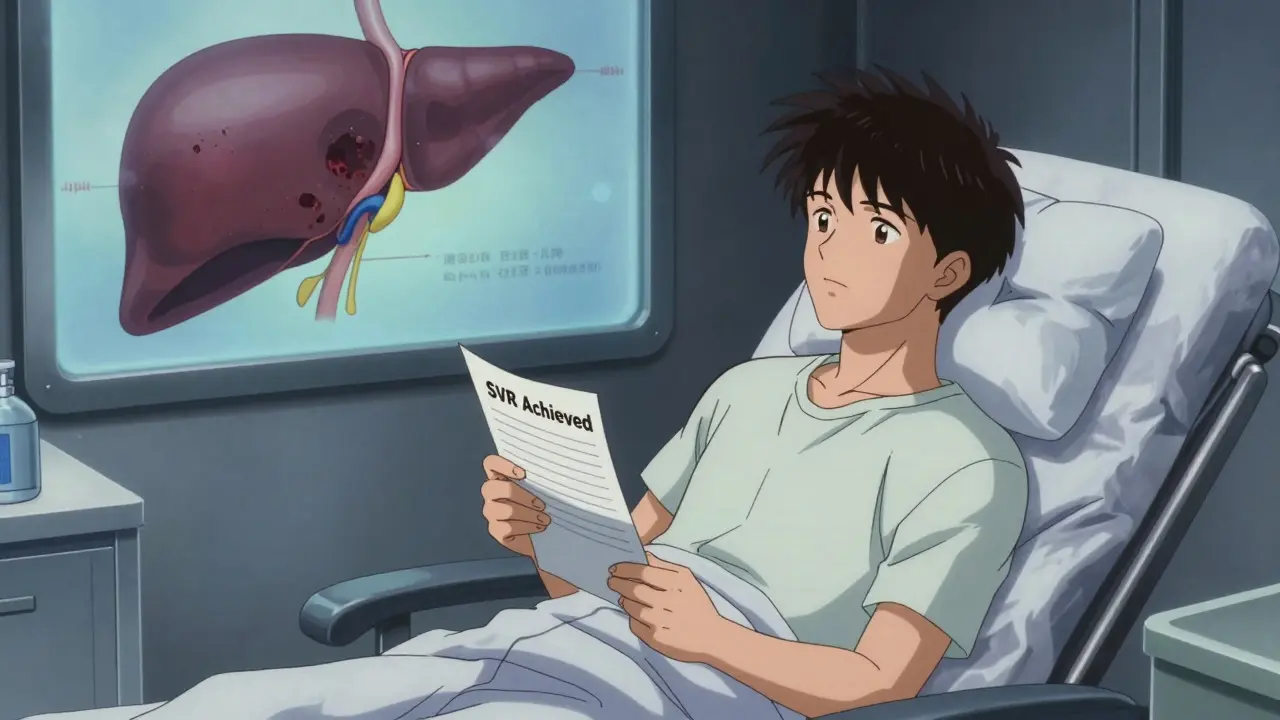
You've gone through the treatment, the tests came back negative, and your doctor told you that you've achieved a Sustained Virologic Response (SVR). In plain English, you're cured of Hepatitis C. It feels like a finish line. But for many people, there is a lingering, uncomfortable question: Do I still need to get screened for liver cancer?
The short answer is: it depends on how much damage was done before the virus was cleared. While curing the virus dramatically lowers your risk, it doesn't always reset your liver to a "factory setting." If you had advanced scarring or cirrhosis, the risk of Hepatocellular Carcinoma (HCC) - the most common type of primary liver cancer - doesn't completely vanish. Understanding where you fit into this risk profile is the difference between unnecessary anxiety and missing a life-saving early diagnosis.
| Factor | Impact After SVR | Action Needed |
|---|---|---|
| Cancer Risk | Reduced by 71% to 79% | Still present for high-risk groups |
| Fibrosis/Cirrhosis | May regress or stay stable | Critical for deciding screening frequency |
| Screening Status | Often neglected after cure | Must continue if cirrhosis was present |
The "Cure" vs. The Damage
To understand why cancer risk persists, we have to distinguish between the virus and the scar tissue. Sustained Virologic Response is a state where the Hepatitis C virus (HCV) is undetectable in the blood 12 to 24 weeks after treatment. Achieving this via Direct-Acting Antivirals (DAAs) is a medical triumph, with cure rates now exceeding 95%.
However, the virus often leaves behind a legacy of inflammation and scarring known as fibrosis. If the liver reached the stage of cirrhosis-where the scarring is extensive-the cellular environment remains unstable. Research shows that even after the virus is gone, certain pro-cancer pathways (like the upregulation of SPHK1) stay active. The liver is essentially "primed" for cancer, even if the trigger (the virus) has been removed. In fact, while untreated patients face a much higher risk, cirrhotic patients who achieve SVR still see an HCC incidence of about 2.12 to 2.28 per 100 person-years.
Who Actually Needs Ongoing Surveillance?
Not everyone who had Hepatitis C needs to spend their life in a radiology clinic. The decision to continue surveillance comes down to your "fibrotic burden." If you never had advanced fibrosis or cirrhosis, your risk of liver cancer after SVR is extremely low. For these patients, the medical consensus is that routine screening is usually unnecessary.
The danger zone starts at stage F3 (advanced fibrosis) and F4 (cirrhosis). This is where global medical guidelines actually disagree, creating a bit of a divide between American and European doctors:
- The European Approach (EASL): They take a more cautious route. The European Association for the Study of the Liver recommends that anyone with F3 or F4 scarring should continue semiannual (every six months) screenings. Their logic is that cirrhosis is easy to misdiagnose; it's better to screen a few too many people than to miss a tumor.
- The American Approach (AASLD): The American Association for the Study of Liver Diseases is more selective. They generally suggest that surveillance is mandatory for those with cirrhosis (F4), but may not be routine for those with advanced fibrosis (F3) who have been cured.
Why the difference? It comes down to a gamble on "fibrosis regression." Some patients see their scarring actually improve after the virus is gone. If an F3 patient regresses to F2, their risk drops significantly. But since we can't always be sure how much the liver has healed, European guidelines lean toward safety.
How Doctors Measure Your Current Risk
You can't see fibrosis on a standard blood test, so doctors use specific tools to decide if you need to keep coming back for ultrasounds. You might hear your doctor mention these two main methods:
- Transient Elastography (FibroScan): This is a non-invasive ultrasound-like test that measures liver stiffness. If your reading is above 11.2 kPa after SVR, you're generally considered high-risk.
- FIB-4 Index: This is a calculation based on your age and a few simple blood markers (AST, ALT, and platelets). A score above 3.25 is often used as a red flag that ongoing monitoring is necessary.
These tools allow doctors to move away from "one size fits all" medicine. Instead of screening everyone, they can identify the small percentage of patients whose liver remains stiff and scarred, and thus, more prone to developing tumors.
The Danger of the "False Finish Line"
There is a significant psychological trap that happens after SVR. When a patient is told they are "cured," they often stop seeing their hepatologist. They feel healthy, the virus is gone, and they assume the danger is over. This is a dangerous misunderstanding.
Data indicates that only about 25% of eligible high-risk patients actually stick to their semiannual ultrasound schedules after SVR. This "screening gap" happens because the patient feels a sense of stabilization. However, liver cancer is often silent. By the time you feel a lump or experience jaundice, the window for a simple, curative resection may have closed. The goal of surveillance isn't to find cancer when it's symptomatic, but to find a tiny nodule that can be removed before it spreads.
What's Next? The Future of Liver Monitoring
The "every six months for the rest of your life" approach is exhausting and expensive. The medical community is working on making this more personalized. We are moving toward a model where your screening interval changes based on how your liver responds to the cure.
For example, researchers are validating dynamic risk calculators. If your FibroScan score drops significantly over two years, your doctor might safely move your screenings from every six months to once a year. There is also excitement around the GALAD score-a blood-based biomarker that combines age, gender, and specific proteins (like AFP and DCP). This could eventually replace or supplement the ultrasound, providing a more accurate "liquid biopsy" for early detection.
If I have SVR, am I 100% safe from liver cancer?
No. While SVR reduces the risk of liver cancer by about 71-79%, it does not eliminate it entirely. If you had cirrhosis or advanced fibrosis before treatment, the structural damage to your liver remains a risk factor for cancer, even without the virus present.
How often should I get screened after being cured of Hep C?
For those with cirrhosis (F4), the standard is usually an ultrasound every six months. For those with advanced fibrosis (F3), recommendations vary by region; European guidelines suggest every six months, while US guidelines are more conservative. Always follow your specialist's specific plan based on your fibrosis score.
Can the liver scarring actually go away after SVR?
Yes, it is possible. Many patients experience fibrosis regression, where some of the scar tissue resolves after the virus is eradicated. This is why doctors use tools like FibroScan periodically to see if your risk level has dropped.
What tests are used for HCC surveillance?
The gold standard is typically an abdominal ultrasound every six months, sometimes paired with a blood test for alpha-fetoprotein (AFP). In some cases, MRI or CT scans are used if the ultrasound is inconclusive.
What is a "good" FibroScan score after SVR?
Generally, a score below 8.4 to 11 kPa suggests a lower risk of HCC. If your score is above 11.2 kPa, you are typically categorized as needing ongoing, regular surveillance.
