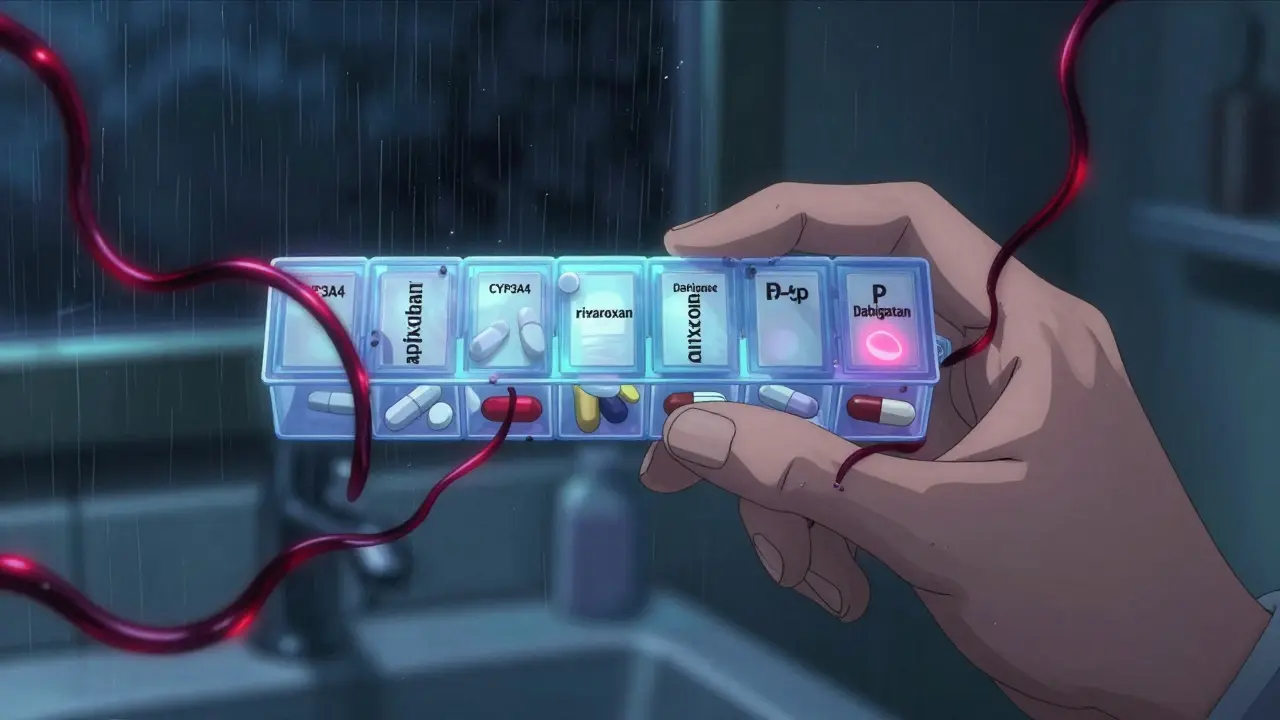
When you're on a blood thinner like apixaban, rivaroxaban, or dabigatran, even a common painkiller or heart medication can change how your anticoagulant works. These drugs, called DOACs (Direct Oral Anticoagulants), were designed to be simpler than warfarin-no weekly blood tests, fewer food restrictions, and fewer interactions. But that doesn’t mean they’re safe with everything. In fact, many patients taking DOACs are also on five or more other medications. That’s where things get risky.
How DOACs Work and Why Interactions Matter
DOACs work by blocking specific proteins in your blood that help clots form. Unlike warfarin, which affects vitamin K, DOACs target either factor Xa (like apixaban and rivaroxaban) or thrombin (like dabigatran). Because they’re metabolized through the liver and kidneys, their levels in your blood can be boosted or lowered by other drugs that use the same pathways.
Two main systems handle this: the CYP3A4 enzyme and the P-gp transporter. If a drug blocks or speeds up either one, your DOAC level can spike or crash. A spike means higher bleeding risk-a nosebleed that won’t stop, bruising without injury, or worse, internal bleeding. A crash means your blood clots too easily, raising your risk of stroke or pulmonary embolism.
It’s not just about what’s in your prescription bottle. Supplements like St. John’s wort, grapefruit juice, or even some herbal teas can interfere. Many people don’t realize these count as medications too.
Which DOACs Are Most Affected?
Not all DOACs react the same way. Here’s how they compare:
- Apixaban: About 20-25% is broken down by CYP3A4. P-gp affects it too. It’s the most forgiving of the group, but still vulnerable to strong inhibitors.
- Rivaroxaban: Half of it goes through CYP3A4. Strong inhibitors like ketoconazole or clarithromycin can raise its levels dangerously. Avoid them.
- Dabigatran: Almost entirely handled by P-gp. That means anything blocking P-gp-like dronedarone or verapamil-can cause a big spike in dabigatran levels.
- Edoxaban: Also P-gp-dependent. Dose reduction is needed with certain drugs.
- Betrixaban: Less commonly used, but follows the same rules as the others.
That’s why switching from one DOAC to another isn’t just a swap. It’s a whole new risk assessment.
Top 5 Dangerous Drug Interactions
These five medications show up again and again in emergency rooms because of DOAC interactions:
- Dronedarone (for atrial fibrillation): Strongly blocks P-gp. Never combine with dabigatran or rivaroxaban. If you’re on edoxaban, your dose must drop from 60 mg to 30 mg daily.
- Amiodarone (heart rhythm drug): Moderately blocks P-gp. Can raise DOAC levels over time. Monitor for bruising or dark stools.
- Diltiazem and Verapamil (blood pressure meds): Diltiazem weakens CYP3A4; verapamil blocks P-gp. With dabigatran, reduce dose to 110 mg twice daily. Apixaban and rivaroxaban are less affected-but still check.
- Ketoconazole, Itraconazole, Clarithromycin (antifungals and antibiotics): Strong CYP3A4 inhibitors. Avoid with rivaroxaban and apixaban unless no alternative exists.
- St. John’s Wort (herbal supplement): A strong CYP3A4 and P-gp inducer. It can slash DOAC levels by up to 50%. Even one week of use can make your blood thinner ineffective.
These aren’t hypothetical risks. Real patients have had strokes after taking St. John’s wort with rivaroxaban. Others bled internally after starting amiodarone without adjusting their DOAC dose.
What About Painkillers and Antidepressants?
You might think NSAIDs like ibuprofen or naproxen are harmless. They don’t change DOAC levels-but they still make bleeding more likely. The same goes for SSRIs like sertraline or fluoxetine. They affect platelet function. Combine them with a DOAC, and your bleeding risk isn’t just doubled-it’s multiplied.
Acetaminophen (paracetamol) is usually safe for pain relief. But even that has limits. Taking more than 3,000 mg a day for weeks can stress the liver and interfere with how DOACs are processed.
Aspirin is tricky. For some people with heart disease, low-dose aspirin is worth the added bleeding risk. For others? It’s unnecessary. Your doctor should weigh the benefit against your personal risk of bleeding-especially if you’re over 75, have a history of ulcers, or have kidney problems.
What If You Have Kidney Problems?
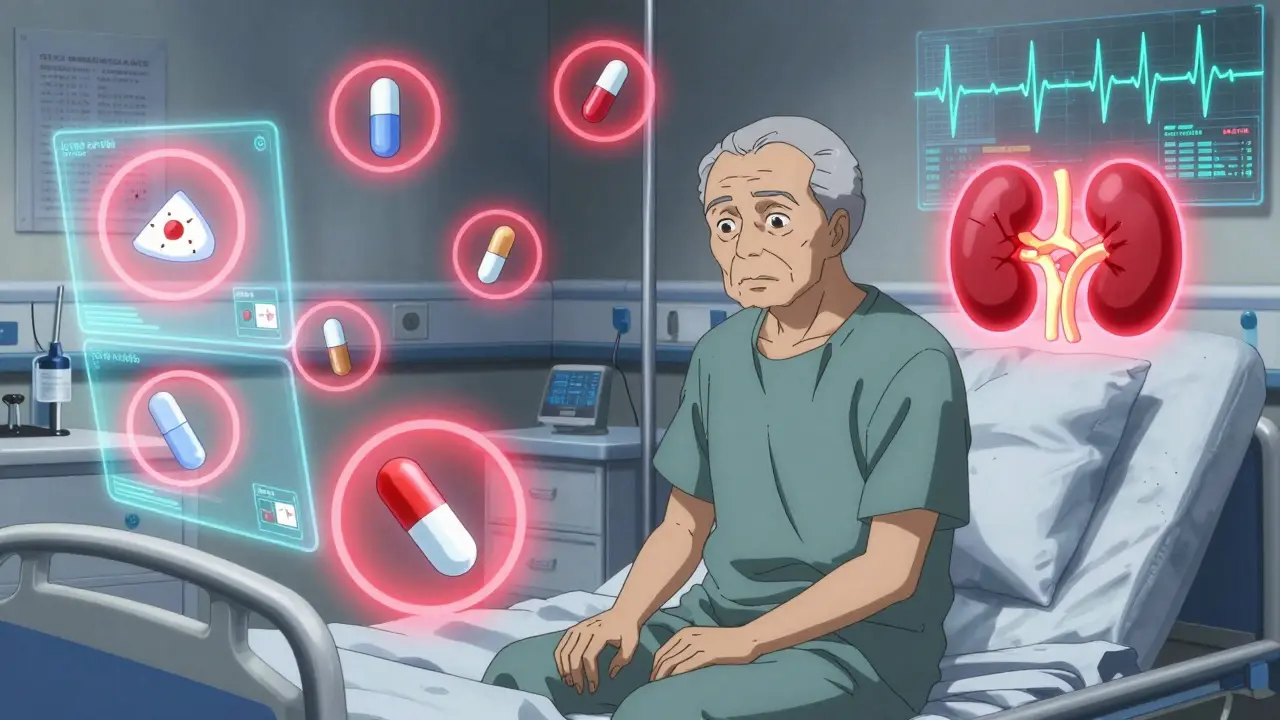
Most DOACs are cleared by the kidneys. If your kidney function is low (eGFR under 30), you’re already on a lower dose. Add a P-gp inhibitor like verapamil on top of that? You’re stacking risks.
For example: A 78-year-old with atrial fibrillation and stage 3 kidney disease is on 2.5 mg apixaban twice daily. Then their doctor adds diltiazem for high blood pressure. Now, their apixaban levels could rise by 30-50%. That’s enough to trigger a major bleed.
Always check your kidney function before starting or changing any medication. And if your eGFR drops after starting a new drug, reevaluate your DOAC dose-even if the label doesn’t say to.
What Should You Do?
Here’s how to stay safe:
- Keep a full list of every pill, patch, capsule, and herbal product you take. Include vitamins, supplements, and over-the-counter meds.
- Bring this list to every doctor’s visit-even if you see different specialists.
- Ask your pharmacist: “Does this new medicine interact with my blood thinner?” Pharmacists are trained to catch these.
- Don’t start or stop anything without talking to your anticoagulation team. That includes CBD oil, turmeric, or fish oil.
- Know the signs of bleeding: unusual bruising, pink or red urine, black or tarry stools, headaches, dizziness, or vomiting blood.
There’s no app or quick fix. It takes vigilance. But it’s worth it. DOACs have cut stroke risk and brain bleeds compared to warfarin. But only if they’re used right.
What’s Next?
Doctors are starting to talk about therapeutic drug monitoring for DOACs-measuring actual drug levels in your blood. Right now, it’s not routine. But in cases where multiple drugs are interacting, or kidney function is unstable, it might become necessary.
Research is also looking at personalized dosing based on age, weight, kidney function, and genetics. One size doesn’t fit all. And the more medications you take, the more you need a tailored plan.
For now, the best protection is awareness. Don’t assume your DOAC is safe just because it’s newer. Don’t assume your doctor knows every interaction. And don’t ignore the little things-like that new supplement you started for “better sleep.”
DOACs are powerful tools. But like any tool, they’re only safe when you understand how they work-and what can break them.
Can I take ibuprofen with a DOAC?
It’s not recommended. Ibuprofen and other NSAIDs don’t change DOAC levels, but they increase bleeding risk by affecting platelets. If you need pain relief, acetaminophen (paracetamol) is safer. Always check with your doctor before using NSAIDs-even for short periods.
Is it safe to take St. John’s Wort with apixaban?
No. St. John’s Wort strongly activates CYP3A4 and P-gp, which can reduce apixaban levels by up to 50%. This makes your blood thinner much less effective, raising your risk of stroke. Stop it immediately and talk to your doctor about alternatives for depression or anxiety.
Do I need blood tests while on a DOAC?
Routine blood tests aren’t needed like they are with warfarin. But if you’re taking multiple interacting drugs, have kidney issues, or start bleeding, your doctor may order a test to check your DOAC level. These tests aren’t perfect but can help in complex cases.
Can I switch from warfarin to a DOAC safely?
Yes, but only under medical supervision. The transition requires careful timing to avoid gaps in protection or overlapping doses. Your doctor will check your INR and may overlap medications briefly. Never switch on your own.
What should I do if I miss a dose of my DOAC?
If you miss a dose and it’s less than half the time until your next dose, take it right away. If it’s more than half the time, skip it and take your next dose at the regular time. Never double up. Missing doses increases clot risk; doubling up increases bleeding risk.
Are DOACs safer than warfarin overall?
Yes, for most people. DOACs carry a lower risk of brain bleeds and don’t require frequent blood tests. But they’re not safer if you’re taking interacting drugs. The key advantage is predictability-only if you avoid interactions. When used correctly, DOACs are safer. When misused, they can be just as dangerous as warfarin.

Emma Hooper
December 31, 2025 AT 16:40Okay but have you ever tried explaining to your grandma why she can’t just take her ‘natural heart tonic’ with her rivaroxaban? She swears St. John’s wort is ‘just tea’ and now she’s got bruises like a rainbow. 😅 I had to print out the whole chart and tape it to her fridge. She still argues, but at least she doesn’t take it anymore.
Martin Viau
January 2, 2026 AT 04:10DOACs are just pharma’s shiny new toy to replace warfarin because they make more money. The truth? They’re more dangerous because nobody tracks them. No INR means no safety net. And don’t get me started on how Canadian docs just prescribe these like candy. We need mandatory testing - not this ‘trust the label’ nonsense.
Marilyn Ferrera
January 3, 2026 AT 06:46St. John’s Wort? Never. Ever. It’s not a supplement-it’s a drug. And it’s a silent killer with DOACs.
Deepika D
January 4, 2026 AT 19:45Guys, I work in a clinic in Bangalore, and we see this ALL the time. Elderly patients come in on apixaban, then start turmeric capsules because their cousin said it’s ‘anti-inflammatory,’ and then they show up with melena. It’s heartbreaking. We don’t have fancy labs here, so we rely on patient education-like, literally sitting down with them, drawing pictures, using their own language. One lady thought ‘blood thinner’ meant it made her blood watery, so she stopped it because she was ‘too thin.’ We had to explain it like she was a 5-year-old. And you know what? She got it. The key isn’t the drug-it’s the person behind it. We need more of that in healthcare. Not just prescriptions. Not just guidelines. Connection.
Branden Temew
January 6, 2026 AT 17:05So let me get this straight… we replaced one drug that required weekly blood draws with five drugs that require you to memorize a 12-page interaction chart… and we call this ‘simpler’? 😂 I mean, congrats, Big Pharma-you turned a manageable chore into a full-time job for patients. And still, no one’s checking levels. Brilliant.
Frank SSS
January 8, 2026 AT 07:46My dad took dabigatran and diltiazem. Got a GI bleed. ICU for 3 days. The doctor said, ‘Oh, we didn’t know he was on that combo.’ Yeah, because he didn’t tell them about the blood pressure med from his chiropractor. That’s the problem. Nobody’s listening. Not the docs, not the patients. We’re all just guessing.
Paul Huppert
January 10, 2026 AT 00:12Just wanted to say thanks for the detailed breakdown. I’ve been on apixaban for 3 years and just started verapamil last month. I was nervous but didn’t know what to ask. This helped me talk to my pharmacist. We lowered my dose just to be safe. Small change, big difference.
Hanna Spittel
January 11, 2026 AT 15:23THEY’RE WATCHING YOU. 🕵️♀️💊 St. John’s wort? It’s not herbal. It’s a spy drug. Big Pharma planted it in the supplement aisle to make you think you’re ‘natural’ while they quietly drop your DOAC levels. I saw a documentary. It’s all connected. 😳
Brady K.
January 12, 2026 AT 06:48Let’s be real-DOACs are only ‘safer’ if you’re a healthy 60-year-old with one prescription and zero supplements. The moment you add a beta-blocker, an NSAID, and ‘just a little CBD oil,’ you’re playing Russian roulette with your cerebral arteries. And doctors? They’re too busy clicking ‘approve’ on EHR pop-ups to care. This isn’t medicine. It’s algorithm-driven triage with a side of denial.
Kayla Kliphardt
January 13, 2026 AT 13:29What about grapefruit juice? I read it’s bad but never saw it on the list. Is that still a concern with apixaban?
anggit marga
January 15, 2026 AT 08:02Why are you all so scared of blood thinners? In Nigeria we don’t even have these drugs. We use traditional herbs and prayer. People live longer. You Westerners over-medicate everything. This post is fearmongering.