
Rifampin & Contraceptive Interaction Checker
Check Your Medication Safety
Recommended Actions:
Imagine taking your birth control pill every single day at the exact same time. You’ve never missed a dose. You feel confident that you are protected from pregnancy. Then, your doctor prescribes Rifampin, a powerful antibiotic used primarily to treat tuberculosis and other serious bacterial infections. Two months later, you discover you are pregnant. This isn’t a rare anomaly or a user error. It is a well-documented, scientifically proven phenomenon known as the rifampin-contraceptive interaction.
Most people believe that antibiotics don’t affect birth control unless they cause vomiting or diarrhea. That’s mostly true for common antibiotics like amoxicillin or azithromycin. But Rifampin is different. It is an outlier in the world of pharmacology. It doesn’t just fight bacteria; it fundamentally changes how your liver processes hormones. If you are prescribed this specific drug, understanding this interaction is not optional-it is critical for your reproductive health.
The Mechanism: How Rifampin Sabotages Hormonal Contraception
To understand why this happens, we need to look inside your liver. Your body uses a family of enzymes called cytochrome P450 (specifically CYP3A4) to break down drugs and hormones. Hormonal contraceptives, medications containing estrogen and/or progestin designed to prevent ovulation and pregnancy rely on maintaining steady levels of these hormones in your blood to work effectively.
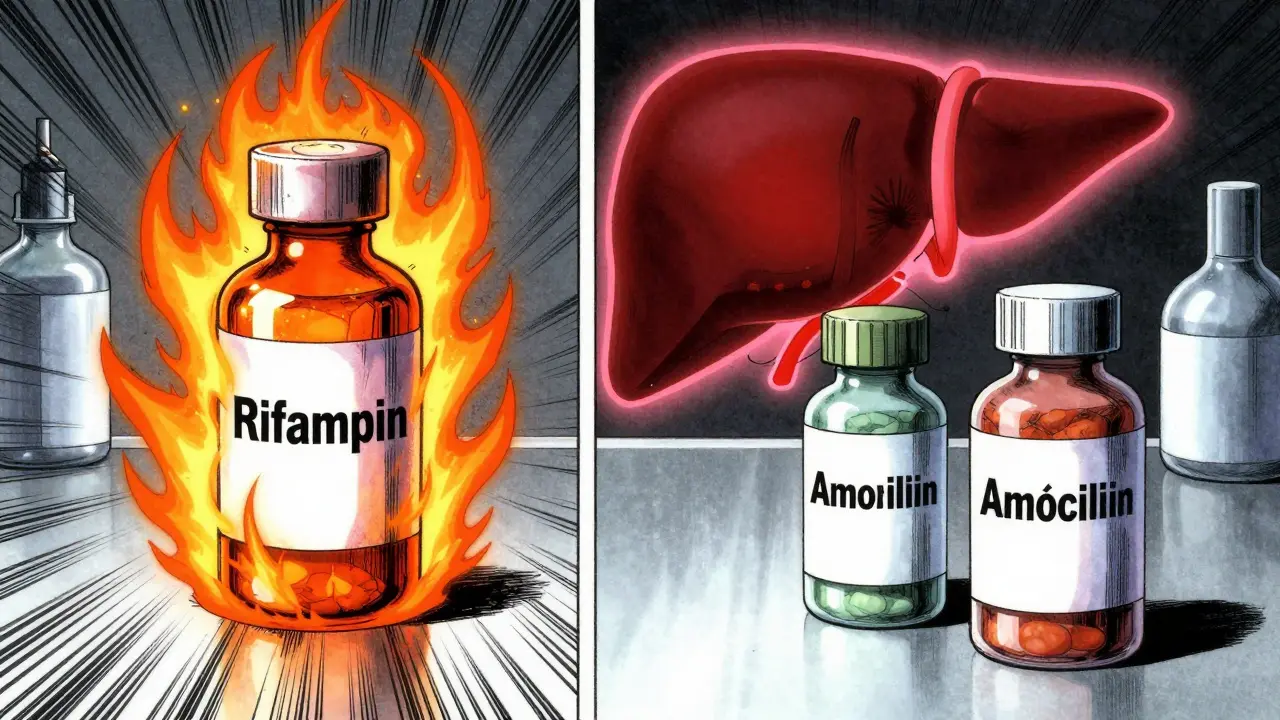
Rifampin is what scientists call a "potent enzyme inducer." Think of it like throwing gasoline on a fire. When you take Rifampin, it signals your liver to produce significantly more of these breaking-down enzymes. A 2024 systematic review published in the National Institutes of Health (NIH) archives revealed that this induction can increase the metabolism of estrogens by up to fourfold.
Here is what that means in practical terms:
- Progestin Exposure Drops: Studies show that the area under the curve (AUC)-a measure of total hormone exposure-drops by 30% to 83% when combined with Rifampin.
- Ethinyl Estradiol Plummets: The estrogen component sees a reduction of 42% to 66% in exposure.
- Faster Clearance: Your body clears these hormones out much faster than usual, meaning they don’t stay in your system long enough to suppress ovulation.
When hormone levels drop below a certain threshold, the suppression of ovulation fails. This leads to "breakthrough ovulation," where an egg is released despite you being on birth control. Without ovulation suppression, pregnancy becomes possible if you have unprotected sex.
Rifampin vs. Other Antibiotics: A Critical Distinction
This is where confusion often sets in. Many women have heard general warnings about "antibiotics and birth control" and assume all antibiotics carry the same risk. They do not. It is vital to distinguish between Rifampin and other common antibiotics.
| Antibiotic Type | Impact on Contraceptive Efficacy | Clinical Evidence |
|---|---|---|
| Rifampin | High Risk: Significantly reduces efficacy | Documented breakthrough ovulation in clinical studies; CDC Category 3 warning |
| Rifabutin | Moderate/Low Risk: Less pronounced effect | Some pharmacokinetic changes, but no detected ovulation in key studies |
| Amoxicillin / Penicillin | No Significant Risk | Systematic reviews find no decrease in progestin levels or ovulation suppression |
| Azithromycin / Erythromycin | No Significant Risk | OBG Project (2018) found no observed differences in ovulation suppression |
The American Academy of Family Physicians explicitly states that Rifampin is the only antibiotic with well-documented evidence of reducing hormonal contraceptive effectiveness through enzyme induction. Other antibiotics might cause gastrointestinal upset (vomiting/diarrhea), which can prevent pill absorption, but they do not chemically alter hormone metabolism like Rifampin does. Knowing this difference helps you avoid unnecessary anxiety over minor infections while remaining vigilant about Rifampin prescriptions.
Understanding the Risk: CDC Classifications and Real-World Data
The Centers for Disease Control and Prevention (CDC) classifies drug interactions using a Medical Eligibility Criteria system. For Rifampin and combined hormonal contraceptives (CHCs), the classification is Category 3.
In plain English, Category 3 means: "The theoretical or proven risks usually outweigh the advantages of using the method." This is a strong warning. It suggests that using standard birth control pills, patches, or rings while on Rifampin is likely ineffective.
Why is the risk so high? Typical failure rates for perfect use of oral contraceptives are around 0.3%. However, when Rifampin accelerates hormone clearance, those protective hormone levels vanish. Case reports from the UK’s Committee on Safety of Medicines documented 150 instances of contraceptive failure associated with antibiotic use between 1970 and 1999, with Rifampin being a primary culprit in many cases involving tuberculosis treatment.
User experiences reinforce this data. On health forums, patients report pregnancies despite "perfect adherence" to their pill schedule while undergoing TB treatment. One survivor noted, "I was on Ortho Tri-Cyclen while taking rifampin... my OB/GYN confirmed it was almost certainly the rifampin interaction." These aren't isolated incidents; they are predictable outcomes of the pharmacokinetics involved.
What Should You Do? Practical Management Strategies
If you have been diagnosed with tuberculosis or another condition requiring Rifampin, you cannot simply stop taking your birth control. Nor should you ignore the interaction. Here is the step-by-step approach recommended by experts, including the CDC and the World Health Organization (WHO).
- Switch to a Non-Hormonal Method Immediately: The most reliable solution is to use a method that does not rely on systemic hormones. The Copper IUD, a non-hormonal intrauterine device that prevents pregnancy by creating a hostile environment for sperm is unaffected by enzyme inducers. Condoms are also an essential backup.
- Add Backup Contraception: If you must continue hormonal methods, you must use a secondary barrier method (like condoms) consistently. Do not rely on the pill alone.
- Extend Protection After Stopping Rifampin: This is the part most people forget. Enzyme induction doesn’t switch off instantly. Your liver remains hyper-active for weeks after your last dose. The CDC recommends continuing backup contraception for 28 days after you finish your course of Rifampin.
- Consult About Implants or Injections: While some progestin-only implants (like Nexplanon) may be less affected than pills, the data is mixed. Discuss with your provider whether a higher-dose regimen or a different delivery method is safer for your specific case.
Do not try to "double up" on pills without medical advice. Taking extra pills can increase the risk of side effects like nausea or blood clots without guaranteeing protection against Rifampin’s metabolic boost.

Why This Matters Beyond Tuberculosis
You might think, "I don’t have TB, so this doesn’t apply to me." While Rifampin is indeed a first-line treatment for tuberculosis, it is also used for other conditions, such as prophylaxis for meningococcal disease or Lyme disease in specific contexts. Additionally, similar drugs in the rifamycin class, like Rifabutin, an antibiotic related to rifampin used to treat mycobacterial infections, are used in HIV-positive patients to prevent MAC infection.
Rifabutin has a milder effect than Rifampin, but it still induces enzymes. The NIH review notes that while data is limited, there is still a potential interaction. Always disclose all medications you are taking, including birth control, to any prescribing physician. Pharmacists are also excellent resources for checking these interactions before you leave the pharmacy counter.
Future Directions and Research Gaps
Science is constantly evolving. As of 2026, researchers are looking into pharmacogenetic testing to identify individuals with specific CYP3A4 enzyme expressions who might be at higher risk for contraceptive failure. Dr. Sarah K. Reeves from Harvard presented preliminary data suggesting that personalized medicine could eventually help tailor contraceptive advice based on genetic makeup.
However, until these tests become routine and affordable, the current standard of care remains conservative: assume the interaction will happen, and plan accordingly. No pharmaceutical company has yet developed a "Rifampin-resistant" birth control pill, so behavioral precautions remain your best defense.
Does Rifampin affect the birth control patch or ring?
Yes. While the patch and ring deliver hormones through the skin rather than the gut, the hormones still enter your bloodstream and are processed by your liver. Since Rifampin increases liver enzyme activity, it accelerates the breakdown of hormones from patches and rings just as it does from pills. The CDC categorizes Rifampin as a Category 3 risk for all combined hormonal contraceptives, including transdermal patches and vaginal rings.
How long after stopping Rifampin do I need to use backup contraception?
You should use backup contraception for 28 days after your last dose of Rifampin. The enzyme-inducing effects of Rifampin persist because the new enzymes your liver produced during treatment take time to degrade naturally. Even though you are no longer taking the antibiotic, your liver is still metabolizing birth control hormones at an accelerated rate for several weeks.
Can I take a higher dose of birth control pills to counteract Rifampin?
This is not recommended without strict medical supervision. Some clinicians historically suggested higher-dose estrogen pills (50 mcg ethinyl estradiol), but evidence for its efficacy is limited. Increasing your dose raises the risk of serious side effects, including blood clots, stroke, and severe nausea, without guaranteeing that ovulation will be suppressed. Switching to a non-hormonal method like a Copper IUD or using condoms is a safer and more reliable strategy.
Do other antibiotics like Amoxicillin interact with birth control?
Generally, no. Extensive research, including a 2018 systematic review by the OBG Project, found no significant decrease in progestin levels or ovulation suppression when combining hormonal contraceptives with non-rifamycin antibiotics like amoxicillin, penicillin, or azithromycin. The only exception is if the antibiotic causes severe vomiting or diarrhea, which can physically prevent the pill from being absorbed in your gut. Rifampin is unique because it chemically alters hormone metabolism.
Is the Copper IUD safe to use while on Rifampin?
Yes, absolutely. The Copper IUD works locally in the uterus by releasing copper ions that are toxic to sperm and eggs. It does not release hormones into your bloodstream, so Rifampin’s effect on liver enzymes has no impact on its efficacy. It is considered one of the most reliable contraceptive options for women undergoing Rifampin therapy.
