
When your stomach feels bloated after a light meal, you’re gassy all day, and diarrhea or constipation won’t quit - it’s easy to blame it on stress or bad food. But for many people, the real culprit is something deeper: Small Intestinal Bacterial Overgrowth, or SIBO. It’s not just a buzzword. It’s a real, measurable condition where bacteria from the large intestine creep into the small intestine and start acting like unwelcome tenants - fermenting food, producing gas, and wrecking nutrient absorption. And while it’s often mistaken for IBS, the treatment is completely different.
What Exactly Is SIBO?
SIBO happens when bacteria that normally live in your colon - where they belong - start multiplying in your small intestine. That’s the part of your gut right after your stomach, where most nutrients get absorbed. Normally, your stomach acid, bile, and the natural movement of your intestines keep those bacteria in check. But when those systems slow down or break down, bacteria take over.
Doctors used to diagnose SIBO by sticking a tube down your throat to collect fluid from your small intestine. That’s invasive, expensive, and not widely available. Today, almost everyone starts with a breath test. Why? Because it’s simple, non-invasive, and works in most clinics. But here’s the catch: it’s not perfect.
How Breath Tests Work - And Why They’re Flawed
The two most common breath tests are the glucose breath test and the lactulose breath test. You fast for 12 hours, then drink a sugar solution. After that, you blow into a bag every 15 to 20 minutes for up to two hours. The machine measures hydrogen and methane gases in your breath. If those numbers spike too high, too fast, you’re flagged for SIBO.
Here’s the science behind it: bacteria in your small intestine feed on the sugar. As they digest it, they release hydrogen or methane gas. That gas gets absorbed into your blood, then exhaled through your lungs. That’s what the test picks up.
But here’s where it gets messy. Glucose is absorbed quickly in the upper part of the small intestine. If your sugar is gone before it reaches the lower areas where bacteria hang out, the test might miss the overgrowth - false negative. Lactulose travels further, so it’s better at catching bacteria deeper down, but it’s more likely to give false positives because it can trigger gas even if there’s no real overgrowth.
A 2019 meta-analysis found the glucose test is 83% specific - meaning if it says you have SIBO, you probably do. But it only catches about half the cases. Lactulose catches more cases, but only about 70% of the time. And that’s not counting the 15-20% of people who don’t produce hydrogen at all - they’re methane producers. If your test doesn’t measure methane, you’re getting half the picture.
And then there’s the preparation. You can’t take antibiotics for four weeks before the test. No laxatives. No probiotics. No proton pump inhibitors (like omeprazole) for at least two weeks. You have to eat a strict low-residue diet for 24-48 hours. Skip one rule, and your results are garbage. One study found that 25-30% of inconclusive tests happened because patients didn’t follow the prep.
Why Some Doctors Don’t Trust Breath Tests
Dr. Hisham Hussan at UC Davis Health says breath tests are only 60% accurate. He’s one of the few doctors in the U.S. doing small bowel aspirates - the old-school method where a scope collects fluid directly from the small intestine. That’s the gold standard: if you have more than 100,000 bacteria per milliliter, you have SIBO. But it’s not practical for most clinics. It costs $2,000. It needs specialized equipment. It’s risky. And contamination rates are high.
Still, he argues that breath tests misdiagnose 40% of patients. That means people are getting antibiotics they don’t need - or missing SIBO entirely. And when you treat the wrong thing, symptoms don’t improve. That’s why some experts call breath tests a screening tool, not a diagnosis.
Dr. Mark Pimentel from Cedars-Sinai, who’s done more SIBO research than almost anyone, says breath tests are the best tool we have - even if they’re flawed. The key, he says, is matching the test result to your symptoms. A high methane level with chronic constipation? That’s likely SIBO. A high hydrogen level with bloating and diarrhea after eating carbs? That’s probably SIBO too. But if your symptoms don’t line up, the test might be wrong.
What Happens After a Positive Test?
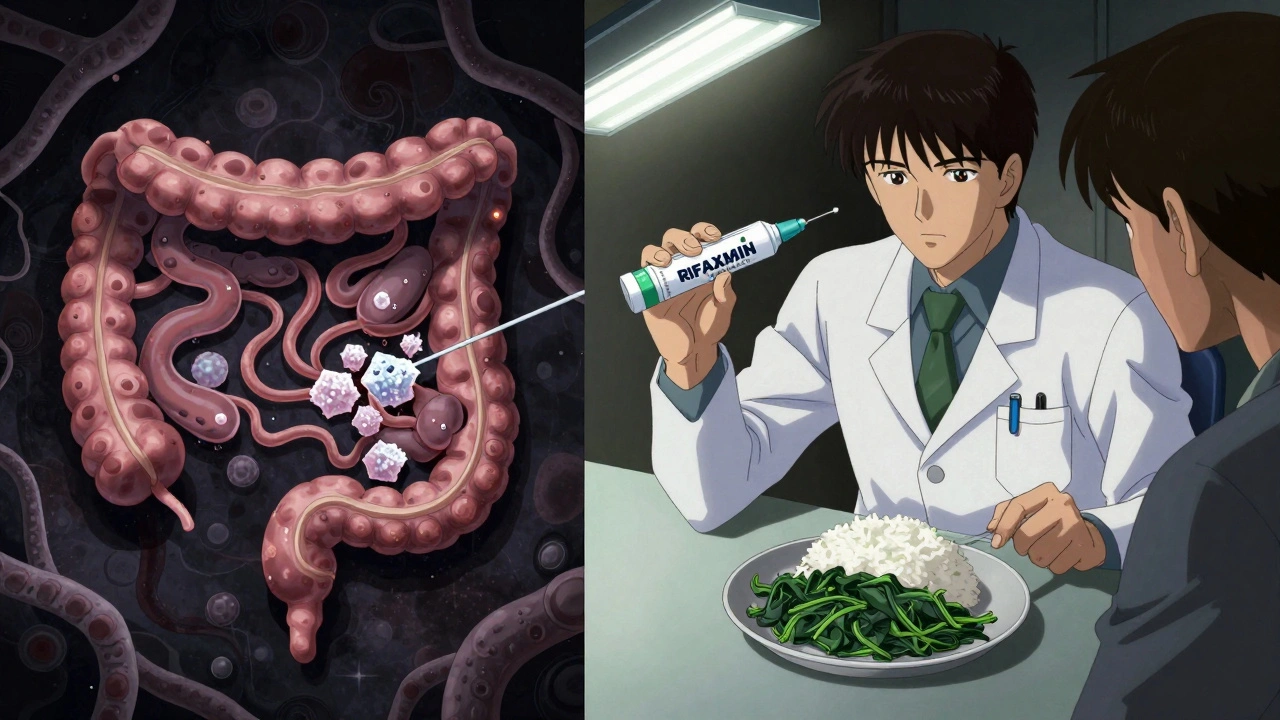
If your breath test is positive, treatment usually starts with antibiotics. Rifaximin (Xifaxan) is the most common. It’s not absorbed into your bloodstream - it stays in your gut. You take 1,200 mg a day for 10 to 14 days. Studies show it works for 40-65% of people. But here’s the kicker: over 40% come back within nine months.
Why? Because antibiotics don’t fix the root cause. If your gut motility is slow, your stomach acid is low, or you’ve had surgery that changed your anatomy, the bacteria will come back. That’s why treatment has to be two-part: kill the bacteria, then fix the system that let them take over.
For methane-dominant SIBO, rifaximin alone doesn’t cut it. You need neomycin mixed in. That combo works better - but it’s harder on your kidneys and hearing. Some doctors now use herbal antimicrobials like oregano oil, berberine, or garlic extract. A 2020 study showed they work just as well as antibiotics for some patients, with fewer side effects.
And then there’s diet. The low-FODMAP diet helps reduce symptoms, but it doesn’t cure SIBO. The SIBO-specific diet - low in fermentable carbs, sugars, and fiber - is more targeted. You eat white rice, eggs, lean meats, low-FODMAP veggies like zucchini and spinach. No fruit, no dairy, no beans, no wheat. It’s strict. But for many, it’s the missing piece.
Who’s at Risk?
SIBO doesn’t happen out of nowhere. It’s usually a side effect of something else. About 30-50% of people with SIBO have had abdominal surgery - especially bowel resections or gastric bypass. Gastroparesis, where the stomach empties too slowly, shows up in 25-40% of cases. Elderly patients with low stomach acid (hypochlorhydria) are at higher risk. So are people on long-term proton pump inhibitors - those drugs cut stomach acid, and without it, bacteria survive and move up.
And then there’s IBS. Up to 85% of people diagnosed with IBS might actually have SIBO. That’s why many doctors now test IBS patients before prescribing antidepressants or antispasmodics. If SIBO is the real problem, those drugs won’t help. Antibiotics and diet will.

What’s Next for SIBO Testing?
Researchers are working on better tools. Mayo Clinic and Johns Hopkins are testing next-gen breath analyzers that can detect more gas types and use AI to interpret patterns. Cedars-Sinai just launched a phase 2 trial for a new device they say will be 85% accurate. There’s also work on stool DNA tests that could identify bacterial species without a breath test.
But for now, breath tests are all we’ve got. And they’re better than nothing. The key is knowing their limits. Don’t treat the test result alone. Treat the person. If your bloating improves with antibiotics and diet, you likely had SIBO - even if the test was borderline. If nothing helps, maybe it’s something else.
Bottom Line
SIBO is real. Breath tests are imperfect. Antibiotics help - but only if you fix the cause. If you’ve been told you have IBS and nothing works, ask for a breath test. Make sure it measures both hydrogen and methane. Follow the prep exactly. And don’t stop there. Work with a doctor who understands that SIBO isn’t just a bug - it’s a symptom of a broken system. Fix the system, and you might finally feel better.
Can a breath test miss SIBO even if I have it?
Yes. Breath tests can miss SIBO in several ways. If you’re a methane producer and the test doesn’t measure methane, it won’t detect your overgrowth. If your gut moves too fast, the sugar gets absorbed before bacteria can ferment it, leading to a false negative. Also, if you didn’t follow the prep - like taking antibiotics or eating carbs before the test - the results can be inaccurate. About 15-20% of people with SIBO get false negatives.
Is SIBO the same as IBS?
No, but they overlap a lot. Up to 85% of people diagnosed with IBS may actually have SIBO. Both cause bloating, gas, diarrhea, and constipation. But IBS is a functional disorder - meaning no clear physical cause. SIBO is a measurable bacterial overgrowth. Treating IBS with antidepressants or fiber supplements won’t fix SIBO. Antibiotics and diet will. That’s why many doctors now test IBS patients for SIBO before starting long-term symptom management.
Can I treat SIBO without antibiotics?
Yes. Herbal antimicrobials like berberine, oregano oil, garlic extract, and neem have been shown in studies to reduce bacterial overgrowth as effectively as rifaximin for some people. A 2020 review found similar success rates between herbs and antibiotics. The downside? Herbs aren’t regulated like drugs, so quality varies. You need to use high-dose, standardized extracts and take them for 4-6 weeks. Many patients prefer herbs because they have fewer side effects and don’t disrupt gut flora as much.
Why does SIBO keep coming back?
Because antibiotics kill the bacteria but don’t fix why they grew in the first place. Common causes include slow gut motility, low stomach acid, past surgery, or long-term PPI use. If those issues aren’t addressed, the bacteria return. That’s why recurrence rates hit 40-60% within a year. Long-term solutions include prokinetic drugs to improve gut movement, stomach acid support, dietary changes, and sometimes even nerve stimulation therapies.
How do I know if my breath test was done right?
Check three things: Did they test for both hydrogen and methane? Did you fast 12 hours and avoid antibiotics, laxatives, and PPIs for weeks before? Did they use a calibrated analyzer like QuinTron or Bedfont? If the lab doesn’t measure methane, or if your prep wasn’t strict, the test isn’t reliable. Ask for a copy of your raw data - a rise of 20 ppm hydrogen or 10 ppm methane above baseline is the standard cutoff. Anything else might be arbitrary.

zac grant
December 5, 2025 AT 04:05Let’s be real - breath tests are a band-aid on a broken system. I’ve seen patients with methane-dominant SIBO get flagged as ‘negative’ because the lab didn’t measure methane. That’s not incompetence, that’s systemic laziness. And don’t get me started on how clinics still use glucose tests like they’re gospel. We’ve known for years lactulose catches more, but insurance won’t cover it. So we’re treating symptoms, not causes. And then wonder why 60% relapse.
Herb protocols? They’re not ‘alternative’ - they’re evidence-based. Berberine + oregano oil has comparable efficacy to rifaximin in RCTs. But nobody wants to talk about it because Big Pharma doesn’t profit from garlic extract.
Martyn Stuart
December 5, 2025 AT 12:31Thank you for this. Finally, someone who gets it. The breath test prep is a minefield - and most patients have no idea they’re sabotaging their own results. I’ve had clients come in after a ‘negative’ test, only to find out they took omeprazole two weeks prior - and didn’t think it mattered. It matters. A lot. The 24-hour low-residue diet isn’t optional - it’s the difference between a diagnostic tool and a coin toss.
Also - methane isn’t just ‘another gas.’ It’s a different beast. Slows motility. Causes constipation. And if your test doesn’t measure it? You’re flying blind. Always ask for the raw data. 10 ppm rise? That’s the cutoff. Not ‘kinda high.’ Not ‘maybe.’ Exactly 10.
Jessica Baydowicz
December 6, 2025 AT 19:38Y’all are overcomplicating this. I had SIBO. Breath test was borderline. I did the herbal protocol - berberine, oregano, garlic - for 6 weeks. No antibiotics. No drama. Just… better. My bloating? Gone. My energy? Back. My life? Changed. Stop waiting for the perfect test. If you feel better after the protocol? You had it. Trust your body more than your lab report.
Joe Lam
December 8, 2025 AT 07:50Oh please. Another ‘SIBO is real’ post from the wellness echo chamber. You people treat a breath test like a DNA scan. It’s not. It’s a rough proxy. And 40% false positive rate? That’s not ‘imperfect’ - that’s dangerous. You’re giving people antibiotics for a condition that might not exist - then blaming them when they get candida or dysbiosis from the treatment. This isn’t medicine. It’s fear-based marketing dressed up as science.
IBS is a functional disorder. Stop pathologizing normal gut variability. You’re creating patients, not healing them.
Augusta Barlow
December 9, 2025 AT 09:47Did you know the FDA doesn’t even regulate breath test machines? The companies that make them - QuinTron, Bedfont - they’re privately owned. No oversight. No audits. And guess who funds most of the ‘research’? Rifaximin’s manufacturer. Coincidence? I think not. The whole SIBO industry is a money pipeline: test → antibiotic → diet plan → supplement bundle. $2,000 for a scope? No. But $400 for a ‘SIBO reset kit’? Absolutely. They don’t want you cured. They want you subscribed.
And don’t get me started on ‘prokinetics’ - those are just stimulants with fancy names. They’re not fixing motility. They’re masking it. Like putting duct tape on a leaking pipe. The real issue? Glyphosate in our food. It paralyzes your gut nerves. That’s why SIBO is exploding. But you won’t hear that from your ‘functional medicine’ guru.
Karl Barrett
December 9, 2025 AT 18:01The philosophical tension here is fascinating. On one hand, we have reductionist medicine: isolate the bug, kill it, move on. On the other, we have systems thinking: the gut is an ecosystem, and dysbiosis is a symptom of upstream failure - motility, acid, anatomy, stress. Breath tests are a snapshot. They don’t tell you why the bacteria migrated. They don’t tell you about vagal tone, or bile flow, or the microbiome’s evolutionary role in fermentation. We’re treating the smoke, not the fire. And yet - we’re stuck with the tools we have. So we use them, imperfectly, with humility. That’s medicine in 2024.
Shofner Lehto
December 9, 2025 AT 21:01My wife had a negative breath test. But she had all the symptoms - bloating after carbs, constipation, fatigue. We did the herbal protocol anyway. Three weeks in, she cried because she could eat a salad without feeling like she’d swallowed a balloon. The test was wrong. Her body wasn’t. Sometimes the clinical data is noise. The lived experience is signal. Trust the person, not the machine.
Michael Feldstein
December 11, 2025 AT 01:28Anyone else notice how the ‘false negative’ crowd always ignores the fact that 15-20% of people are non-hydrogen producers? If your test doesn’t measure methane, you’re literally missing half the population. And yet, most clinics still only offer hydrogen. It’s not incompetence - it’s cost. Labs don’t want to buy dual-gas analyzers. Insurance won’t pay. So patients get misdiagnosed. And then blamed for ‘not following protocol.’
Also - if you’re on PPIs and have bloating? Stop blaming the food. Stop the PPI. See what happens. Low stomach acid is the silent driver here. And no, apple cider vinegar won’t fix it. But hydrochloric acid supplements? Might. Just sayin’.
Alex Piddington
December 11, 2025 AT 02:01As a clinician who’s reviewed over 200 breath tests, I can confirm: the variability in lab protocols is staggering. One lab uses a 20 ppm hydrogen cutoff. Another uses 12. One measures methane at 10 ppm, another at 5. The same patient, same day, different labs - different diagnoses. That’s not science. That’s chaos. We need standardized guidelines. And until we get them, treat the patient, not the number. If symptoms resolve with diet and antimicrobials? That’s your diagnosis.
Rachel Bonaparte
December 11, 2025 AT 05:11Okay, but what if the real problem isn’t SIBO at all? What if it’s mold toxicity? Or heavy metals? Or Lyme? I’ve seen patients treated for SIBO for years - antibiotics, herbs, diets - and nothing worked. Then they find out they’re living in a moldy house. Symptoms vanish in 3 weeks. SIBO is just a distraction. The real enemy? Environmental toxins. But no one wants to talk about that. Too messy. Too expensive. Too inconvenient. So we give you a breath test and a pill. Easy. Profitable. Wrong.
And don’t even get me started on the ‘low-FODMAP’ cult. It’s not a diet. It’s a starvation protocol disguised as medicine. You’re not healing your gut. You’re starving your microbiome. Then wonder why you get worse after 6 months.
Ashley Elliott
December 12, 2025 AT 13:22Just wanted to say - thank you for writing this. I’ve been told I have IBS for 7 years. Took me 3 years to find a doctor who even knew what SIBO was. Got the breath test - methane positive. Did the 14-day rifaximin + neomycin. Then the 8-week low-FODMAP + prokinetic. I can now eat bread again. Not all of it. But some. And I’m not bloated every day. It’s not perfect. But it’s better. And I didn’t need to believe in crystals to get here. Just science. And patience.
Pavan Kankala
December 12, 2025 AT 16:31They’re lying. All of them. The breath test? A scam. The antibiotics? A cover-up. The real cause? GMOs. They’ve been altering the gut flora since the 90s. The FDA knows. The WHO knows. But they won’t say it. Because the corporations own the labs. The doctors. The journals. You think this is medicine? It’s control. They want you dependent. On tests. On pills. On diets. But the truth? Your body heals itself - if you stop poisoning it. Stop eating processed food. Stop taking drugs. Stop trusting ‘experts.’ Go primal. Eat meat. Vegetables. Salt. That’s it. No tests. No pills. Just nature. You’ll thank me in 6 months.