Ever wonder why some pills you’re prescribed cost hundreds of dollars a month-even after years on the market-while others drop to a few bucks as soon as a generic shows up? It’s not random. It’s not a mistake. It’s a system designed to protect profits, not just patients.
Patents Aren’t the Whole Story
Most people think if a drug’s patent expires, a generic version automatically pops up. That’s not true. Patents last 20 years from the date they’re filed, but by the time a drug hits the market, it’s often already five to seven years into that clock. That leaves only 13 to 15 years of market exclusivity before generics can legally enter. But even after that window closes, many drugs still have no generic alternatives.The reason? Companies don’t just rely on one patent. They build patent thickets-a web of overlapping protections covering everything from the chemical structure to the way it’s packaged, the coating on the pill, even the shape of the tablet. Each new patent adds another layer of legal protection. One study found these tactics extend market exclusivity by an average of 3.2 years beyond the original patent. That’s more than three years of higher prices for patients.
Complex Drugs Can’t Be Copied
Some drugs aren’t just hard to copy-they’re nearly impossible. Take Premarin, a hormone therapy made from the urine of pregnant mares. It contains a mix of over a dozen estrogen compounds, many of which aren’t even fully identified. No lab can replicate that exact blend. So even though the patent expired decades ago, there’s still no true generic. The FDA can’t approve a copy because there’s no way to prove it’s the same.Biologics are another category entirely. These aren’t simple chemicals. They’re made from living cells-like Humira for arthritis or Enbrel for autoimmune disease. You can’t just mix the same ingredients in a factory. You need a living system to produce them. That’s why they don’t have generics. They have biosimilars, which are close but not identical. And getting approval for a biosimilar takes years of extra testing. The first biosimilar for Humira didn’t hit the U.S. market until 2023, even though its patent expired in 2016.
Manufacturing Is a Minefield
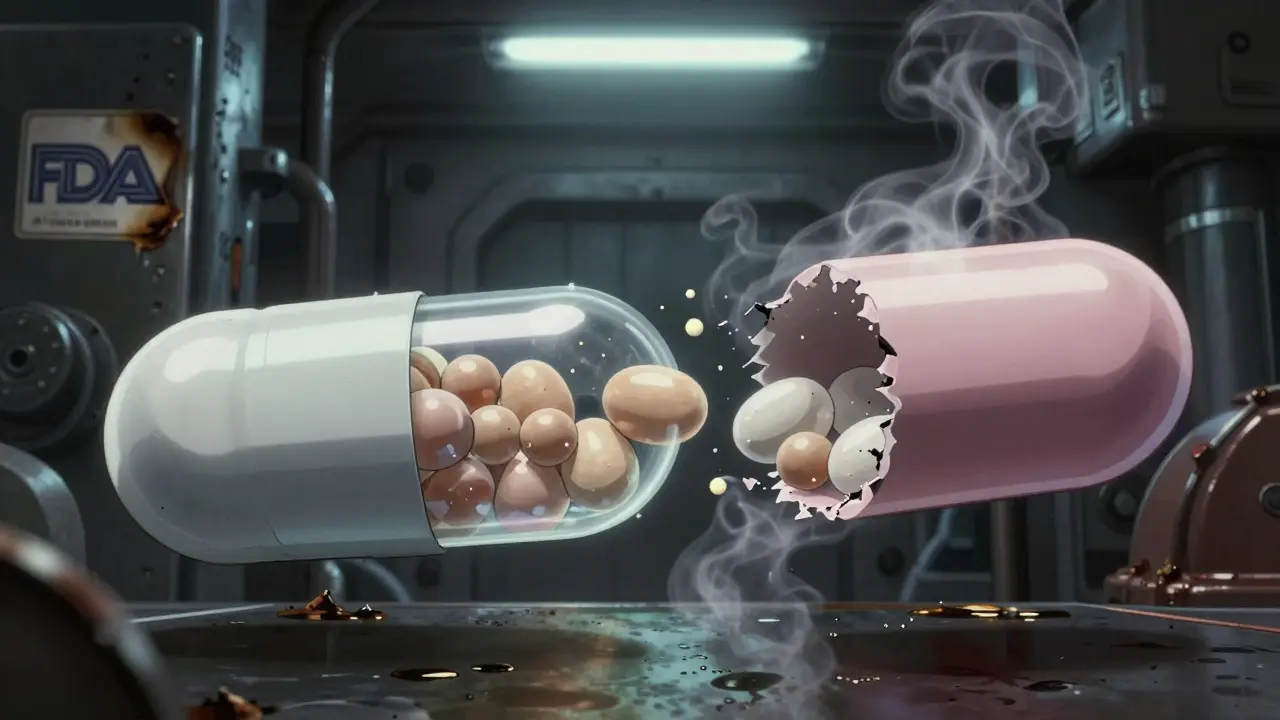
Even for simple pills, making a generic isn’t as easy as it sounds. Take extended-release drugs like Prozac Weekly. The capsule isn’t just a pill-it’s a tiny time-release machine. The coating, the beads inside, the way the drug dissolves over days-all of it has to match perfectly. A tiny change in an inactive ingredient can alter how the drug works in your body.The FDA requires generics to be bioequivalent-meaning they deliver the same amount of active ingredient into your bloodstream within a narrow range (80% to 125% of the brand). For drugs with a narrow therapeutic index-like seizure meds or blood thinners-those margins are dangerous. A 5% difference could mean a seizure or a clot. So the FDA demands extra testing. That costs money. And if the market is small, generic makers won’t bother.
Product Hopping and Pay-for-Delay
Here’s where things get shady. Some companies use a trick called product hopping. Just before a patent expires, they release a slightly modified version-maybe a new pill shape, a new delivery system, or a combo with another drug. They get a new patent. Then they push doctors and patients to switch. The old drug? Discontinued. Suddenly, there’s no generic left because the version you can copy no longer exists.The EpiPen is a textbook case. Mylan kept updating the design, got new patents, and kept the price high for over a decade. Even after the original patent expired, no generic could legally compete because the only version on the market was the protected one.
Then there’s pay-for-delay. Big pharma pays generic companies to stay away. In exchange for millions of dollars, the generic maker agrees not to launch its version for years. The FTC found 297 of these deals between 1999 and 2012, costing consumers over $3.5 billion a year. These deals are now illegal under the CREATES Act, but enforcement is slow, and loopholes still exist.
Why It Matters for Patients
The cost difference isn’t small. Brand-name drugs without generics can cost 437% more than their generic counterparts. A patient on Gleevec for leukemia paid $14,500 a month before the generic arrived in 2016. After? $850. That’s not a discount-it’s a lifeline.But even when generics exist, some patients report feeling different on them. One user on PatientsLikeMe said the generic version of Spiriva (for COPD) didn’t work as well as the brand. They didn’t feel the same relief. That’s not always about chemistry. Sometimes it’s about the delivery device-the inhaler’s mechanics, the powder’s texture, how it hits the lungs. For patients with chronic conditions, even a small change can feel like a big one.
Medicare data shows that 22% of people taking drugs without generics spend over $5,000 a year out of pocket. For those on generics? Only 8%. That’s not just inconvenient-it’s life-altering.
What’s Changing?
The FDA has started cracking down. Under GDUFA III, they’ve prioritized reviewing complex generics. In 2022, approvals for these harder-to-make drugs jumped 27% from the year before. The CREATES Act now forces brand-name companies to hand over samples so generics can test their products. No more blocking access.Biosimilars are also picking up speed. There were 32 approved in 2022. By 2025, that number could hit 75. But insulin? That’s still a tough one. Complex formulations, patent battles, and manufacturing hurdles mean most insulin brands won’t face true generic competition until at least 2026.
What Can You Do?
If you’re stuck with a pricey brand-name drug, ask your doctor or pharmacist if there’s a therapeutic alternative. For example, when Viibryd had no generic, pharmacists successfully switched 68% of patients to sertraline-a cheaper, equally effective option. Don’t assume you have no choices.Check the FDA’s Orange Book. It lists every patent and exclusivity period for branded drugs. You might be surprised to see that a drug’s patent expired years ago-but a legal barrier is still blocking generics.
And if you’re paying too much, speak up. Patient advocacy groups, state attorneys general, and even Congress are starting to push back. The more people demand transparency, the harder it is for companies to hide behind patents and delays.
Eventually, most drugs will have generics. But for now, the ones that don’t? They’re not rare exceptions. They’re the result of deliberate choices-legal, financial, and technical-that keep prices high and profits higher.
Why don’t all expired-patent drugs have generic versions?
Not all expired-patent drugs have generics because of patent thickets, complex manufacturing requirements, regulatory delays, or legal tactics like product hopping and pay-for-delay settlements. Some drugs, like biologics or those with unique delivery systems, simply can’t be copied exactly, requiring years of additional testing for biosimilars or complex generics.
Can a generic drug be less effective than the brand name?
By law, generics must be bioequivalent-meaning they deliver the same active ingredient at the same rate and amount as the brand. For most drugs, they work just as well. But for medications with a narrow therapeutic index-like epilepsy or thyroid drugs-some patients report differences. This may be due to inactive ingredients or delivery systems, not the active drug itself. Always talk to your doctor if you feel a change after switching.
What’s the difference between a generic and a biosimilar?
Generics are exact chemical copies of small-molecule drugs, like pills or injections made from synthetic compounds. Biosimilars are similar-but not identical-copies of biologics, which are made from living cells. Because biologics are complex, biosimilars can’t be exact matches, so they require more testing and are not considered interchangeable unless specifically approved as such by the FDA.
How long does it take for a generic to appear after a patent expires?
It can take anywhere from a few months to over a decade. Simple drugs often see generics within months. Complex ones-like inhalers, extended-release pills, or biologics-can take years due to testing, litigation, or lack of incentive. In some cases, companies delay entry through legal settlements or by controlling access to drug samples, which the CREATES Act now tries to prevent.
Are there any drugs that will never have generics?
Yes. Some drugs-especially ultra-complex biologics, orphan drugs for rare diseases, and those with naturally derived ingredients like Premarin-are unlikely to ever have true generics. Manufacturing them exactly is impossible, and the market is too small to justify the cost of development. These will likely remain brand-only, with biosimilars or alternatives as the only options.

Dan Mack
January 16, 2026 AT 11:34The system is rigged from day one. Patents? Just the tip of the iceberg. Big Pharma owns the FDA, the Congress, and your doctor’s prescription pad. They don’t want generics because generics don’t have lobbyists. You think this is about science? Nah. It’s about control. And they’ll kill you slowly with bills before they let a $2 pill replace their $15,000 magic bullet.
Ayush Pareek
January 16, 2026 AT 16:40It’s heartbreaking to see how many people struggle just to breathe or survive because of this. But there’s hope. More people are waking up. More pharmacists are pushing alternatives. Small steps, but they matter. Keep asking questions. Keep pushing back. You’re not alone in this.
Nicholas Urmaza
January 17, 2026 AT 15:57Stop whining and start advocating. If you’re paying $5000 a year for a drug, you’re not a victim-you’re a target. Demand transparency. File complaints. Contact your reps. The system only bends when it’s pressured. Your silence is their profit margin. Wake up.
Sarah Mailloux
January 18, 2026 AT 00:34I switched from brand Spiriva to generic and felt totally different at first. Felt like I was suffocating. Turned out it was the inhaler design-not the drug. Got my doc to order the same device with the generic. Life changed. Don’t assume it’s the medicine. Check the delivery.
Nilesh Khedekar
January 18, 2026 AT 10:52Of course they don’t want generics… they’re corporations, not hospitals. They’re not here to heal you-they’re here to harvest you. Pay-for-delay? That’s not a loophole, that’s a crime scene. And the FDA? They’re just the janitors cleaning up the mess after the party. Meanwhile, your insulin is still $300 because someone’s yacht needs polishing.
Jami Reynolds
January 19, 2026 AT 11:37Did you know the FDA’s bioequivalence range of 80-125% was chosen because it’s statistically convenient, not medically safe? That’s a 45% window for variation. For anticoagulants, that’s a death sentence waiting to happen. They’re not protecting you. They’re protecting the industry’s liability.
RUTH DE OLIVEIRA ALVES
January 21, 2026 AT 09:13It is imperative to recognize that the structural barriers to generic drug development are not merely technical or regulatory in nature; they are fundamentally economic and political. The current framework incentivizes prolonged market exclusivity through strategic patenting, which systematically undermines public health equity. A reevaluation of intellectual property norms within pharmaceuticals is not merely advisable-it is ethically obligatory.
Nat Young
January 22, 2026 AT 18:50Actually, most people who say generics don’t work are just psychologically attached to the brand. Placebo effect is real. Also, Premarin isn’t uncopyable-it’s just that no one wants to make it because it’s gross and the profit margin is trash. And biosimilars? They’re not ‘close’-they’re just legally allowed to be different enough to avoid lawsuits. You think Humira’s biosimilar is the same? It’s not. It’s a knockoff with a fancy label.
Annie Choi
January 23, 2026 AT 01:01As someone who’s been on biologics for a decade, I can tell you-biosimilars are a game-changer. The first one I got? 70% cheaper. Same results. The delivery device matters more than people admit. But the real win? Knowing my insurer isn’t bleeding me dry anymore. We need more of this. More access. Less red tape. Less corporate theater.
Arjun Seth
January 24, 2026 AT 12:39People are sheep. They take pills like they’re candy and never ask why. The truth? You’re being farmed. The government lets them do this because they’re paid. The FDA? Paid. Doctors? Paid. Even your pharmacist is paid to nod and say it’s fine. Wake up. The system is designed to keep you dependent. You’re not sick-you’re a revenue stream.