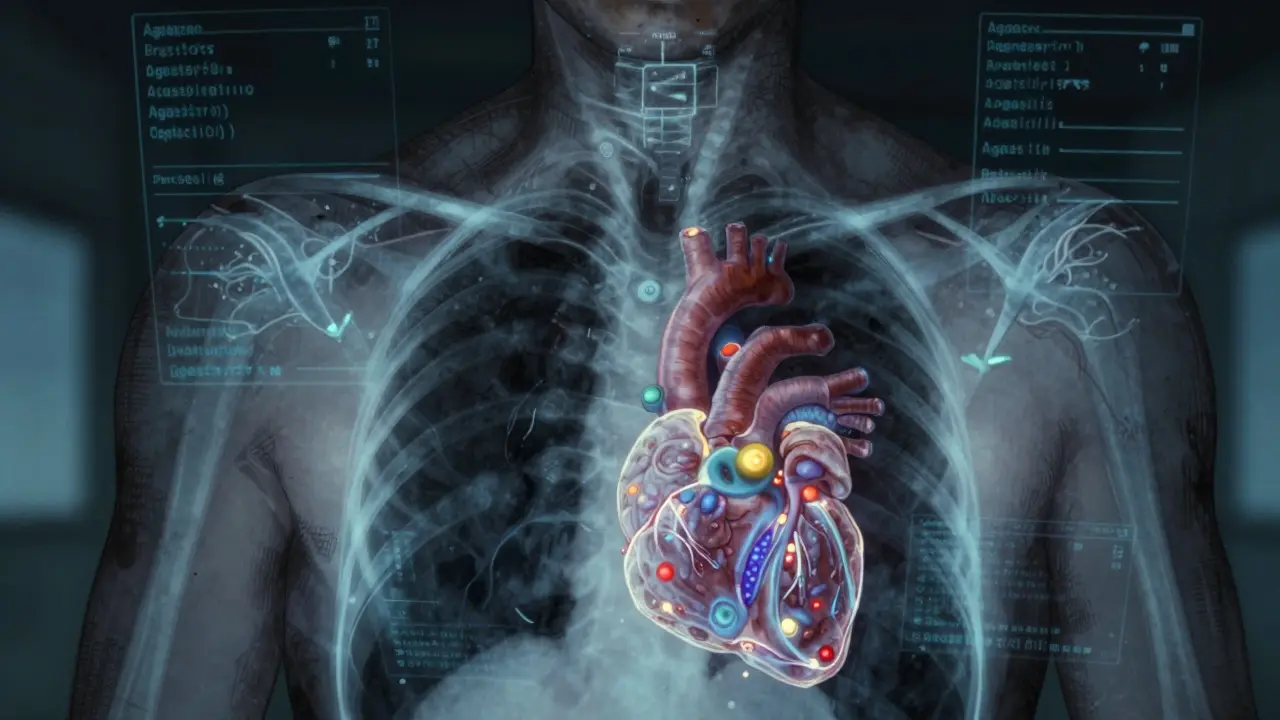
Most people don’t know their arteries are silently clogging up years before they feel any symptoms. A simple, non-invasive CT scan can show you exactly how much calcified plaque is building up in your heart’s arteries - and what that means for your risk of a heart attack. This isn’t science fiction. It’s called a coronary calcium score, and it’s one of the most powerful tools we have to catch heart disease before it’s too late.
What Exactly Is a Coronary Calcium Score?
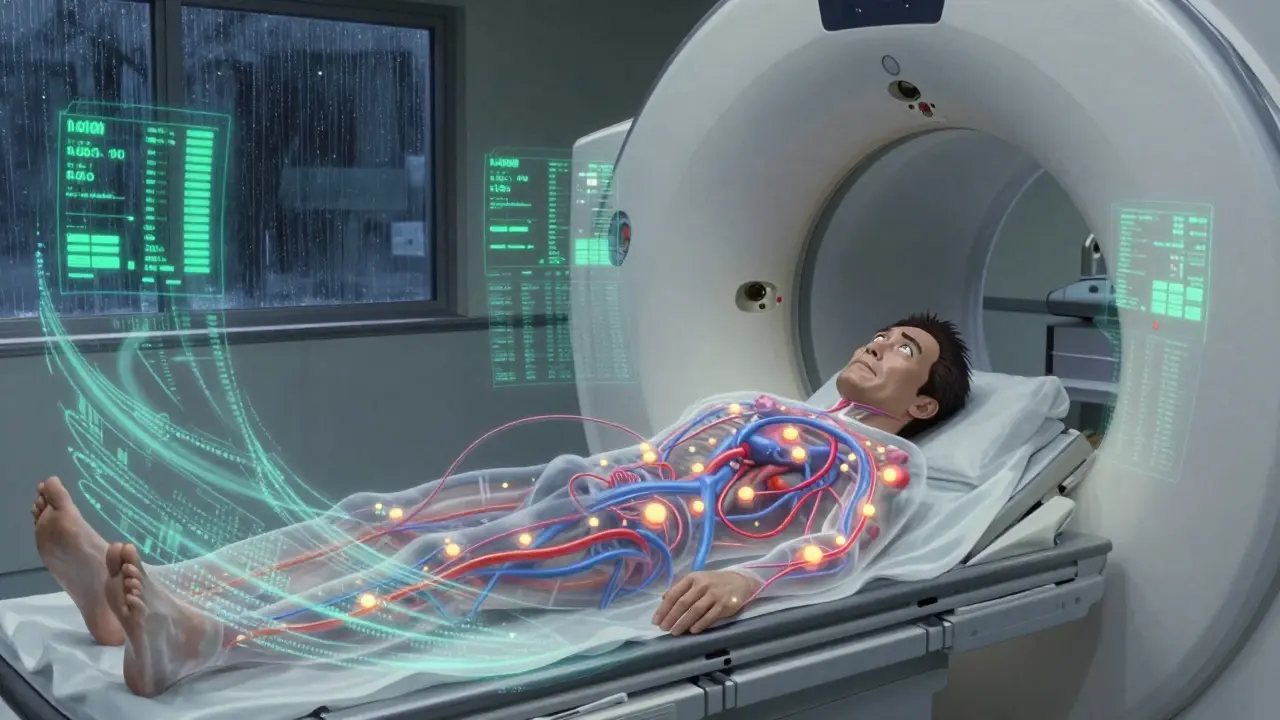
A coronary calcium score comes from a special type of CT scan that looks specifically at your coronary arteries - the blood vessels that feed your heart muscle. Unlike a regular chest X-ray or even a stress test, this scan doesn’t need dye, needles, or exercise. You lie still for about 10 to 15 seconds while the machine takes hundreds of images. The computer then calculates how much calcium is stuck in those arteries.
Calcium doesn’t just show up randomly. It’s a marker. When cholesterol and other fats build up in artery walls, the body tries to repair the damage by depositing calcium. Over time, that creates hard, stable plaques. The more calcium detected, the more plaque is present. A score of zero means no detectable calcium - a good sign. But even a score of 1 or 2 means you already have early signs of heart disease.
This test doesn’t measure soft, fatty plaques - the kind that can rupture and cause sudden heart attacks. But it does measure the bulk of what’s already there. And here’s the key: if you have calcium, you have atherosclerosis. No exceptions.
How Is the Score Calculated?
The number you get is called the Agatston score, named after the radiologist who created the system in 1990. It’s not just counting spots. The software looks at each calcified area, measures its size, and assigns a density value from 1 to 4 based on how bright it appears on the scan. Brighter = denser calcium = higher score.
Then it adds it all up. The result? A single number between 0 and over 1,000. But numbers alone don’t tell the full story. What matters more is how your score compares to others your age, sex, and ethnicity. That’s called the MESA percentile. For example, a score of 150 might be in the 75th percentile for a 55-year-old man - meaning 75% of men his age have less calcium than he does. That’s a red flag, even if he feels fine.
Here’s what the numbers typically mean:
- 0: No detectable calcium. Very low risk of heart disease in the next 5-10 years.
- 1-10: Minimal plaque. Slight risk, but not urgent.
- 11-100: Mild plaque. Some narrowing. Lifestyle changes are strongly advised.
- 101-400: Moderate plaque. About a 75% higher risk of a cardiac event compared to someone with zero.
- 401+: Extensive plaque. High risk. Often means more than half of an artery is blocked.
The American College of Cardiology and American Heart Association say if your score is above the 75th percentile for your group, you should be on more aggressive treatment - even if your cholesterol and blood pressure look fine.
Why This Test Beats Traditional Risk Calculators
Most doctors use tools like the Pooled Cohort Equations to estimate your 10-year risk of heart disease. They ask about age, cholesterol, blood pressure, smoking, and diabetes. But here’s the problem: they’re wrong about 20-30% of the time. They label people as “low risk” when they actually have heavy plaque - and vice versa.
A 2020 study in Circulation found that coronary calcium scoring reclassified risk in nearly half of people with intermediate risk. That means a lot of people who were told they didn’t need statins suddenly should be on them. And others who were told to take pills might not need them at all.
Dr. Khurram Nasir from Houston Methodist Hospital put it plainly: “CAC scoring directs appropriate statin therapy in 35% of patients who would’ve been missed by traditional tools.”
Think of it like this: cholesterol levels are like looking at the fuel tank. Calcium score is like looking under the hood to see if the engine is already clogged.
Who Should Get This Test?
This isn’t for everyone. It’s targeted. The guidelines say it’s most useful for adults aged 40 to 75 who are at intermediate risk - meaning they have a 7.5% to 20% chance of a heart attack in the next 10 years based on standard calculators.
That usually includes people who:
- Have high LDL cholesterol (160 mg/dL or higher)
- Have a family history of early heart disease (before age 55 for men, 65 for women)
- Have high blood pressure or are a current smoker
- Have prediabetes or type 2 diabetes
- Are overweight or sedentary
It’s not recommended for people under 40, unless there’s a strong genetic history. It’s also not needed if you’ve already had a heart attack, stent, or bypass - you’re already in high-risk mode.
And here’s something surprising: the 2023 European Association of Preventive Cardiology now says this test should be a first-line tool for anyone with a family history of premature heart disease - even if their cholesterol looks normal.
What the Scan Can’t Tell You
It’s important to know the limits. This scan only sees calcified plaque. About 20-30% of plaque is soft and doesn’t show up on a calcium scan. That’s why some people with a score of zero still have heart attacks - their plaques were fatty and unstable, not calcified.
If your doctor suspects you have blockages despite a low score, they might recommend a coronary CT angiography (CCTA). That test uses contrast dye and gives a full 3D view of all plaque types. But it’s more expensive, involves more radiation, and isn’t needed for most people.
Also, calcium scoring can overestimate risk in people with kidney disease. Their blood vessels calcify for reasons unrelated to heart disease. So if you’re on dialysis or have advanced kidney disease, this test isn’t reliable.
What Happens After You Get Your Score?
Getting your score isn’t the end - it’s the start. A high score doesn’t mean you’re doomed. It means you’ve been given a wake-up call.
Here’s what usually follows:
- Score 0-10: Keep doing what you’re doing. Maybe add more exercise.
- Score 11-100: Start a statin if you’re over 50. Focus on diet, quit smoking, lose weight if needed.
- Score 101-400: Strongly consider high-intensity statins. Blood pressure control becomes critical. Consider daily aspirin if you’re at high risk.
- Score 401+: This is serious. You’re at high risk. You need high-intensity statins, strict blood pressure control, and likely a referral to a cardiologist for further testing.
One Reddit user, u/CardioCurious, shared: “My score was 142 at age 52 - higher than 78% of men my age. It scared me into finally quitting smoking and starting statins, which my doctor had recommended for years but I ignored.”
That’s the power of this test. It turns abstract risk into something visible. And for many, that’s the push they need.
Cost, Coverage, and Accessibility
Most people pay between $100 and $300 out of pocket. Insurance doesn’t always cover it. Medicare doesn’t pay for it as part of the Annual Wellness Visit. But 28% of private insurers will cover it if your doctor documents your intermediate risk.
That’s a big barrier. In 2023, only 15% of eligible patients actually got the test, mainly because doctors didn’t order it or patients couldn’t afford it. But demand is rising. In the U.S., over 2.1 million scans were done in 2022 - up 17% from the year before.
Facilities need specialized CT machines (64-slice or higher), trained techs, and radiologists who know how to interpret the results. It’s not something your local clinic can do without the right equipment and expertise.
What’s Next for Calcium Scoring?
Technology is getting better. New AI algorithms can now cut radiation exposure by 40% without losing image quality. That means safer, more repeatable scans.
The National Institutes of Health is running a 10,000-person study called the CAC Consortium to finally define exact treatment thresholds. For example: if your score is 300, should you get a statin? What if you’re 45 and have no other risk factors? We’re close to answers.
And more cardiologists are pushing for wider use. In a 2023 survey, 87% of cardiologists said they’d recommend broader adoption - if insurance would just cover it.
Coronary calcium scoring isn’t perfect. But it’s one of the few tools that gives you a real, measurable snapshot of your heart’s health - before you have symptoms, before you have pain, before you have a crisis.
It’s not about fear. It’s about knowledge. And knowledge, in this case, can save your life.

Sophia Daniels
December 25, 2025 AT 03:22This test is literally a wake-up call wrapped in a CT machine-no cap. I got mine done after my uncle dropped dead at 54 with a 'clean' cholesterol report. Score was 587. Five hundred eighty-seven. My doctor just shrugged and said 'maybe try kale.' Bro, I had more calcium in my arteries than my grandma’s porcelain collection. Now I’m on a statin, cut out all processed food, and do 10K steps daily. If you’re over 40 and haven’t done this, you’re playing Russian roulette with your heart. 🚨
Steven Destiny
December 25, 2025 AT 10:58Stop waiting for symptoms. That’s the whole point. My dad had a heart attack at 58-zero warning. He was 'low risk' by the charts. Got his CAC scan two years later-score of 892. He’s alive today because he finally listened. This isn’t hype. It’s survival. If your doc won’t order it, go to a private clinic. Pay out of pocket. It’s cheaper than a funeral. Period.
Erwin Asilom
December 27, 2025 AT 04:13The Agatston score is an excellent surrogate marker for atherosclerotic burden, and its predictive value exceeds traditional risk factors in intermediate-risk populations. However, one must interpret it within the context of clinical presentation, lipid profiles, and inflammatory markers. A score above the 75th percentile warrants statin therapy per ACC/AHA guidelines, but lifestyle modification remains foundational. The test’s utility lies in its ability to personalize risk stratification beyond population-based algorithms.
Brittany Fuhs
December 27, 2025 AT 18:59It’s funny how Americans think a $200 scan is the solution to everything. In Europe, we’ve known this for decades. We don’t need fancy CTs to know that sugar, processed meat, and sitting all day will kill you. If you’re not eating real food, exercising, and sleeping well, no scan will save you. The real problem? Lazy doctors and lazy patients. Get your act together before you waste money on tech that won’t fix your junk diet.
Becky Baker
December 27, 2025 AT 23:44my doc told me i was fine but my score was 210. i was like... wait, what? i eat salad sometimes. turns out i was one of those 'intermediate risk' people who got mislabeled. now i take statins and i swear i feel better. like my energy came back. who knew clogging your arteries makes you tired??
Natasha Sandra
December 29, 2025 AT 09:33Just got my score back-18. 😅 I was nervous but it’s low! I’ve been doing yoga, eating more greens, and cutting out soda. I’m so proud of myself!! 🌿💪❤️ Also, I started a little heart health journal. Maybe I’ll post pics later? #CACWin #HeartHealthJourney
Sumler Luu
December 29, 2025 AT 09:53I appreciate the clarity here. For those who’ve had heart events or are on dialysis, this test isn’t useful. And for people under 40 without family history, it’s not recommended. Let’s not turn this into a panic-inducing trend. It’s a tool-not a mandate. Talk to your doctor about your individual risk before rushing into it.
Sandeep Jain
December 29, 2025 AT 19:09i live in india and we dont have access to this test easily. my uncle had a heart attack at 49, he never checked anything. i just started walking 4km every morning and eating less oil. maybe one day we can get this here too. thank you for sharing this info.
Fabio Raphael
December 30, 2025 AT 16:23What’s the long-term data on repeat scans? Like, if someone gets a score of 150 at 50, then another at 60 and it’s 200-does that mean progression? Or can lifestyle reverse it? I’ve seen conflicting info. Anyone have personal experience tracking theirs over time?
Amy Lesleighter (Wales)
December 30, 2025 AT 23:58Calcium in your arteries isn’t the enemy. It’s your body trying to patch a leak. The real problem is the cholesterol gunk that started it. Fix the cause, not the symptom. Eat real food. Move. Sleep. Stress less. The scan just shows you how bad you’ve let it get. You’re not doomed. You’re just late to the party.