
H2 Blocker & Antimicrobial Interaction Checker
Ready to Analyze
Select your medications on the left to see potential interaction risks and management strategies.
Interaction Analysis
Interaction Type
Description of the mechanism.
Key Takeaway
Summary of impact.
Recommended Management Strategies
Picture this: you are taking a daily pill for heartburn or acid reflux. It works great. But then you pick up a prescription for an antifungal or antiviral medication, and suddenly, that helpful heartburn pill is silently sabotaging your treatment. This isn't just a theoretical risk-it happens more often than you might think.
H2 blockers, the common class of drugs used to reduce stomach acid, can dramatically change how your body absorbs other medications. When combined with certain antivirals and antifungals, these interactions can lead to treatment failure or unexpected side effects. Understanding these dynamics is crucial for anyone managing multiple prescriptions.
How H2 Blockers Change Your Stomach Environment
To understand why these interactions happen, we first need to look at what H2 blockers actually do. Formally known as histamine H2-receptor antagonists (H2RAs), these medications work by blocking histamine receptors in your stomach lining. The result? A significant reduction in gastric acid production.
Your stomach normally maintains a highly acidic environment, with a pH between 1 and 3. This acidity is essential for breaking down food and dissolving many medications so they can be absorbed into your bloodstream. When you take an H2 blocker, that pH rises to approximately 4-6. While this feels better for your esophagus, it creates a hostile environment for drugs that require acid to dissolve properly.
Famotidine (Pepcid), cimetidine (Tagamet), and nizatidine (Axid) are the primary H2 blockers currently available in the United States. Famotidine is the most commonly prescribed due to its safety profile. Ranitidine (Zantac) was withdrawn from the market in 2020 due to contamination issues with NDMA, a probable carcinogen, leaving fewer options but also simplifying the interaction landscape.
The key takeaway here is simple: if a drug needs acid to work, raising your stomach's pH can stop it from being absorbed effectively. This is the foundation of most interactions between H2 blockers and antimicrobial agents.
The Cimetidine Factor: Enzyme Inhibition
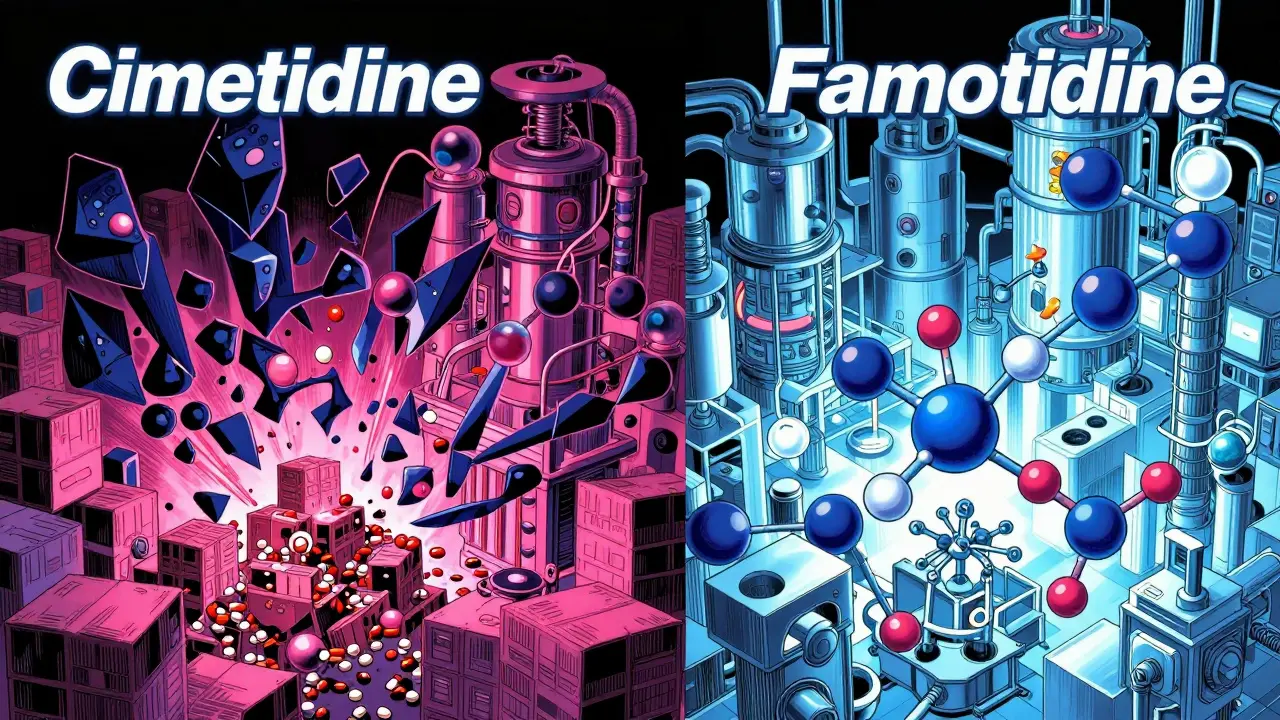
Not all H2 blockers are created equal when it comes to drug interactions. Cimetidine stands out as the most problematic agent in this class. Unlike famotidine or nizatidine, cimetidine contains an imidazole ring structure that allows it to inhibit cytochrome P450 (CYP450) enzymes in the liver.
These enzymes are responsible for metabolizing a vast number of medications. When cimetidine inhibits them, drugs stay in your system longer and at higher concentrations. This can lead to toxicity. For example, cimetidine can increase plasma levels of voriconazole, a potent antifungal, by up to 40%. Conversely, some drugs can inhibit the metabolism of cimetidine itself, creating a bidirectional risk.
In contrast, famotidine has minimal effect on CYP450 enzymes. This makes it a much safer choice for patients who need acid suppression while taking complex medication regimens. If you are currently taking cimetidine alongside antivirals or antifungals, talking to your doctor about switching to famotidine could be a critical step.
Antifungal Interactions: The Absorption Problem
Antifungal medications, particularly azoles, are heavily impacted by changes in gastric pH. Itraconazole is the poster child for this issue. It requires an acidic environment to dissolve and be absorbed. Studies published in the Journal of Antimicrobial Chemotherapy have shown that co-administering H2 blockers can reduce itraconazole bioavailability by 40% to 60%. That means nearly half of the drug never reaches your bloodstream.
However, not all antifungals behave this way. Fluconazole, for instance, is highly water-soluble and does not rely on stomach acid for absorption. Its efficacy remains largely unaffected by H2 blockers. This distinction is vital because fluconazole is often used for common fungal infections, while itraconazole is reserved for more serious systemic infections.
Voriconazole and posaconazole also present challenges. Voriconazole interacts with cimetidine through enzyme inhibition, while posaconazole suffers from pH-dependent absorption issues. The FDA labeling for posaconazole specifically recommends separating its administration from H2 blockers by at least two hours to mitigate these risks.
| Antifungal Agent | pH Sensitivity | CYP450 Interaction Risk | Management Strategy |
|---|---|---|---|
| Itraconazole | High (Requires Acid) | Moderate | Avoid H2 blockers; use oral solution if necessary |
| Fluconazole | Low (Water Soluble) | Low | Generally safe with H2 blockers |
| Voriconazole | Moderate | High (with Cimetidine) | Monitor blood levels; avoid cimetidine |
| Posaconazole | High (Requires Acid) | Moderate | Separate dosing by 2+ hours |
| Isavuconazole | Low | Low | Safer alternative with fewer interactions |
Antiviral Interactions: Reduced Exposure
Antiviral medications face similar hurdles. Many modern antivirals, including HIV protease inhibitors like atazanavir, have low aqueous solubility. They depend on stomach acid to break down and enter the bloodstream. Clinical studies have demonstrated that taking atazanavir with famotidine can reduce drug exposure by up to 77%. This level of reduction can easily push viral loads back above detectable limits, leading to treatment failure.
Dasatinib, a tyrosine kinase inhibitor with antiviral properties, also experiences significantly reduced absorption when paired with H2 blockers. The FDA reviewed 42 antiviral drug labels in 2022 and found that 68% contained specific warnings about co-administration with acid-reducing agents. While antacids caused exposure changes in 45% of cases, H2 blockers were implicated in 28% of clinically relevant reductions.
The mechanism here is primarily pH-dependent dissolution. Without sufficient acid, the drug particles remain intact and pass through the digestive system unabsorbed. This is not a minor fluctuation; it is a fundamental breakdown in the drug's delivery system.
Strategic Timing and Management Strategies
You don't always have to choose between treating your reflux and fighting an infection. Strategic timing can often resolve these conflicts. Because H2 blockers have a relatively short duration of action (6-12 hours) compared to proton pump inhibitors (PPIs), which suppress acid for 24+ hours, there is a window of opportunity.
For pH-dependent drugs like atazanavir, the FDA recommends administering the antiviral at least two hours before the H2 blocker. This allows the antiviral to absorb in a more acidic environment before the H2 blocker raises the pH. Similarly, for posaconazole, separating doses by two hours can maintain therapeutic efficacy.
Another option is formulation selection. Itraconazole is available as both tablets and an oral solution. The tablets require acid for absorption, but the oral solution contains citric acid, which helps it dissolve even in a less acidic stomach. If you must take an H2 blocker, the solution form of itraconazole is a viable alternative to tablets.
Therapeutic drug monitoring is another powerful tool. For voriconazole, doctors can measure trough levels in your blood after two weeks of therapy. Target levels are typically between 2-5 mcg/mL. If levels are too low, dosage adjustments can be made to compensate for reduced absorption.

Why Famotidine Is Usually the Safer Bet
If you need an H2 blocker while taking antivirals or antifungals, famotidine is generally the preferred choice. Data from IQVIA shows that between 2019 and 2022, famotidine replaced cimetidine in 92% of cases where patients were also receiving azole antifungals. This shift reflects a broader clinical awareness of cimetidine's high interaction potential.
Cimetidine accounts for 63% of documented significant interactions between H2 blockers and antifungals/antivirals, according to the University of Liverpool's HEP Drug Interactions Group. Famotidine, lacking the imidazole ring, does not inhibit CYP450 enzymes and thus avoids the metabolic interaction risks associated with cimetidine.
While famotidine still affects gastric pH, its impact is easier to manage through timing strategies. It does not carry the same baggage of enzyme inhibition, making it a cleaner option for complex medication regimens.
Future Directions and Patient Awareness
The medical community is becoming increasingly aware of these pitfalls. A 2022 survey of hospital pharmacists revealed that only 43% consistently provided specific timing instructions to patients receiving itraconazole with concurrent acid suppression therapy. This gap in communication contributes to preventable treatment failures.
Regulatory bodies are responding. The FDA proposed rulemaking in late 2023 to require specific administration timing instructions for all drugs significantly affected by gastric pH. Modeling data suggests this could reduce interaction-related adverse events by an estimated 35%.
Emerging research is also exploring novel formulations. Lipid-based delivery systems for itraconazole, currently in early clinical trials, aim to eliminate pH-dependent absorption issues altogether. These innovations promise to decouple antifungal efficacy from stomach acidity, potentially ending this class of interactions in the future.
Until then, proactive communication with your healthcare provider is your best defense. Never assume that a heartburn pill is harmless when added to your regimen. Ask specifically about pH-dependent interactions and enzyme inhibition. Your health depends on the details.
Can I take famotidine with fluconazole?
Yes, generally you can. Fluconazole is highly water-soluble and does not rely on stomach acid for absorption. Unlike itraconazole, its bioavailability is not significantly reduced by the increased gastric pH caused by famotidine. However, always consult your doctor to ensure there are no other individual factors affecting your treatment.
Why is cimetidine considered riskier than famotidine?
Cimetidine inhibits cytochrome P450 (CYP450) enzymes in the liver, which are responsible for metabolizing many drugs, including several antivirals and antifungals. This inhibition can cause drug levels to build up to toxic concentrations. Famotidine lacks this enzyme-inhibiting property, making it a safer option for patients on complex medication regimens.
How should I time my medications if I take an H2 blocker and an antiviral?
For pH-dependent antivirals like atazanavir, the FDA recommends taking the antiviral at least two hours before the H2 blocker. This allows the antiviral to absorb in a more acidic environment before the H2 blocker raises your stomach's pH. Always follow the specific timing instructions provided by your pharmacist or doctor.
Does ranitidine interact with antifungals?
Ranitidine (Zantac) was withdrawn from the U.S. market in 2020 due to contamination with NDMA, a probable carcinogen. Therefore, it is no longer available for prescription. Current guidelines focus on famotidine, cimetidine, and nizatidine. Among these, famotidine is preferred for its lower interaction profile.
What is the difference between H2 blockers and PPIs regarding drug interactions?
Both H2 blockers and proton pump inhibitors (PPIs) raise gastric pH, but PPIs provide stronger and longer-lasting acid suppression (24+ hours vs. 6-12 hours for H2 blockers). This prolonged effect makes it harder to time around pH-dependent drugs. Additionally, some PPIs like omeprazole inhibit CYP2C19 enzymes, adding another layer of interaction risk that H2 blockers like famotidine do not share.
Can I take itraconazole tablets with famotidine?
It is not recommended. Itraconazole tablets require an acidic environment for proper dissolution and absorption. Co-administration with famotidine can reduce bioavailability by 40-60%. If you must take an H2 blocker, ask your doctor about using the itraconazole oral solution, which contains citric acid and maintains adequate absorption even at higher pH levels.
Are there any antifungals that are safe to take with H2 blockers?
Fluconazole is generally safe to take with H2 blockers because it is water-soluble and does not depend on stomach acid for absorption. Isavuconazole is another option with fewer CYP-mediated interactions and lower pH sensitivity compared to other azoles. Always verify with your healthcare provider based on your specific medical history.
What should I do if I forget to separate my doses?
If you accidentally take your H2 blocker and pH-dependent antiviral or antifungal at the same time, do not panic, but inform your doctor or pharmacist. They may recommend monitoring your symptoms or checking drug levels in your blood to ensure therapeutic efficacy. Do not double up on doses without professional advice.

Mohit Patil
July 5, 2026 AT 22:31they dont want you to know this because the big pharma wants you sick and dependent on more pills
its a conspiracy to keep us weak and paying them billions while our immune systems rot from inside out
who do you think is really behind all these 'interactions' anyway? its not just chemistry its control
Chandan Sharma
July 6, 2026 AT 16:19One must appreciate the sheer elegance of pharmacokinetics when properly understood by those with the intellectual capacity to grasp it
The interplay between gastric pH and drug bioavailability is not merely a medical footnote but a profound demonstration of how biological systems are governed by precise chemical laws that most laymen ignore at their peril
To suggest otherwise is to engage in a vulgar simplification of complex physiological realities that have been meticulously documented in peer-reviewed literature for decades
Katie Dixon
July 7, 2026 AT 05:44honestly i feel like we are losing touch with what it means to be truly alive when we rely so much on these synthetic compounds to regulate our bodies
it makes me wonder if our souls are being eroded by the very things we use to survive
we need to reconnect with nature and stop letting these corporate entities dictate our health outcomes through fear and confusion about interactions
Anna Bartle
July 8, 2026 AT 17:25This is such an important topic!!
I always tell my patients to double check their timing!
Famotidine is definitely the safer bet here.
Please talk to your pharmacist!
Stay safe everyone!!!
Chris Munton
July 10, 2026 AT 16:43It is morally reprehensible that healthcare providers often fail to communicate these critical details to patients who are already vulnerable and seeking relief from genuine suffering
The systemic negligence displayed in this gap of communication reveals a deep-seated arrogance within the medical establishment that prioritizes convenience over patient safety and ethical responsibility
We must demand better standards and hold those accountable who treat human lives as mere statistics in a flawed bureaucratic machine that values profit over well-being
Amrithaa Thayaparan
July 12, 2026 AT 04:01u people r so clueless abt how this stuff works
its obvious that the elites want u confused so u cant fight back against the system
stop trusting the mainstream narrative and wake up to the truth about these drugs
they r poisoning us slowly and no one cares except the few who see the matrix
Paul Diamond
July 13, 2026 AT 06:12The philosophical implications of altering our internal environment to accommodate external agents are quite profound
When we change the acidity of our stomachs we are essentially rewriting the fundamental conditions under which our bodies operate
This raises questions about authenticity and whether we are truly ourselves when our physiology is constantly mediated by pharmaceutical interventions that shift the balance of power between natural processes and artificial corrections
Peter Sverla
July 14, 2026 AT 14:31i read this whole thing and i am still trying to wrap my head around the cimetidine enzyme inhibition part
does that mean if i take tagamet i basically stop my liver from working properly or just slow it down?
i guess i need to look up cytochrome p450 more closely because the article mentions voriconazole levels going up by 40 percent which seems huge