Medication Heartburn Risk Calculator
Your Risk Assessment
Select medications you currently take to estimate your heartburn risk
Your Estimated Risk
Your estimated risk is %
Based on your selected medications
Important: This is a general risk estimate. Actual risk depends on factors like dosage, timing, and individual sensitivity.
Recommended Prevention Steps:
- Drink a full glass of water (8 oz) with each pill
- Stay upright for 30-60 minutes after taking medications
- Take NSAIDs with food (not with antibiotics)
- Consider taking an antacid 30 minutes before NSAIDs
Many people take pills every day without thinking twice - until their stomach starts burning, or they feel that familiar acid rising into their throat. If you’ve ever had heartburn after popping an ibuprofen, or felt like your chest was on fire after taking doxycycline, you’re not alone. Medications that are meant to help you can sometimes hurt your digestive system more than they help. The good news? Most of these side effects are preventable - and you don’t have to stop taking your medicine to feel better.
Why Your Pills Are Causing Heartburn
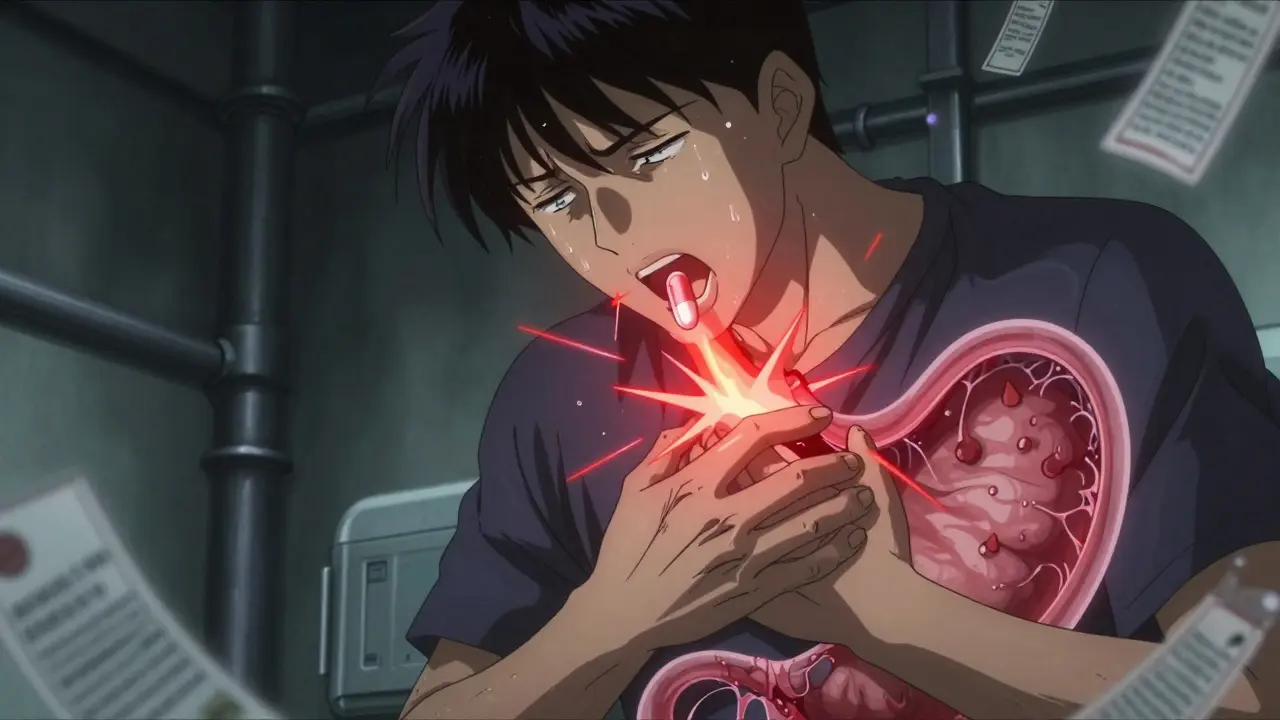
Not all heartburn comes from spicy food or late-night snacks. A big chunk of it - up to 20% of cases - is caused by the drugs you’re taking. It happens in three main ways: some pills directly scratch or burn the lining of your esophagus or stomach; others relax the muscle that normally keeps stomach acid where it belongs; and some actually trick your stomach into making more acid than it should. The worst offenders? NSAIDs like ibuprofen and aspirin. These are the most common cause of medication-related heartburn. They block a protective chemical in your stomach called prostaglandin. Without it, your stomach lining becomes vulnerable. About 20-30% of people who take ibuprofen regularly get heartburn. Aspirin isn’t far behind, hitting 15-25% of users. If you’re on these drugs long-term, your chance of developing a stomach ulcer jumps from 1-2% to 15-30%. Then there are antibiotics - especially tetracycline and doxycycline. These aren’t meant to burn your throat, but if you swallow them with just a sip of water or lie down right after, they can get stuck and dissolve slowly in your esophagus. That’s when ulcers form. About 12% of people who don’t follow the rules get pill-induced esophagitis. Symptoms can show up within just a couple of hours. Other big names on the list: calcium channel blockers like amlodipine (used for high blood pressure) relax the lower esophageal sphincter, letting acid sneak up. About 10-20% of users get heartburn from them. Theophylline, used for asthma, weakens that same muscle by 30-50%. And metformin, the go-to diabetes pill, causes nausea, bloating, and heartburn in 20-30% of new users - though for most, it fades after 2-4 weeks. Even bisphosphonates like alendronate (for osteoporosis) can be dangerous. If you don’t take them right, they can cause severe esophageal injuries. In 5-10% of cases, people end up in the hospital because of it.Which Medications Are Riskiest? A Quick Comparison
| Medication Type | Common Examples | Heartburn Risk | Key Risk Factor |
|---|---|---|---|
| NSAIDs | Ibuprofen, Aspirin, Naproxen | 15-30% | Long-term use without food |
| Tetracycline Antibiotics | Doxycycline, Tetracycline | 12% | Swallowed with little water, lying down |
| Calcium Channel Blockers | Amlodipine, Nifedipine | 10-20% | Relaxes esophageal sphincter |
| Asthma Meds | Theophylline | 25-30% | Weakens sphincter pressure |
| Diabetes Meds | Metformin | 20-30% | Usually improves after 2-4 weeks |
| Bisphosphonates | Alendronate, Risedronate | 5-10% | Requires strict upright position |
| Potassium Chloride | K-Dur, Klor-Con | 15-20% | Highly irritating if stuck in esophagus |

What You Can Do Right Now
You don’t need to quit your meds. You just need to take them smarter. Drink a full glass of water - at least 8 ounces - every time you swallow a pill. This isn’t just advice; it’s a proven shield. For doxycycline and bisphosphonates, this cuts esophagitis risk by 60-70%. Water washes the pill down before it has time to stick and dissolve. Stay upright for at least 30-60 minutes after taking your pill. No lying down. No slouching on the couch. No napping. This simple step prevents 80-90% of pill-induced esophagitis. It’s why doctors tell you to take alendronate first thing in the morning - you’re supposed to stay standing or sitting for an hour after. Take NSAIDs with food. Not just a cracker. A full meal. Eating before or with ibuprofen or aspirin reduces heartburn by 40-50%. Food acts like a buffer, protecting your stomach lining from the drug’s harsh effects. But here’s the catch: don’t do this with antibiotics like doxycycline or bisphosphonates. Food can block their absorption and make them useless. Try an antacid before your pill. If you know you’ll be taking ibuprofen, pop an over-the-counter antacid like Tums or Rolaids 30 minutes beforehand. It lowers your chance of heartburn by 30-40%. It’s not a cure-all, but it’s a quick, cheap shield. Ask about proton pump inhibitors (PPIs). If you’re on long-term NSAIDs and have a history of stomach issues, your doctor might prescribe omeprazole or pantoprazole. These drugs cut stomach acid production by 90%. Studies show they reduce NSAID-related ulcers by 70-80%. They’re not for everyone - long-term use has risks - but for high-risk patients, they’re a game-changer.Red Flags: When to Call Your Doctor
Not all heartburn is harmless. Some signs mean something serious is going on. Don’t ignore these:- Chest pain - especially if it feels like pressure or tightness, not just burning. Could be heart-related.
- Difficulty swallowing - food feels stuck, or you feel pain when you swallow. Could mean scarring or ulcers in your esophagus.
- Blood in vomit or stool - dark, tarry stools or red streaks in vomit. This is a medical emergency.
- Unexplained weight loss - if you’re losing weight and have ongoing heartburn, it could signal something deeper.

Dave Old-Wolf
January 6, 2026 AT 15:43Man, I took doxycycline once and thought my throat was falling apart. Turns out I drank half a glass of water and laid right back down. Stupid. Now I chug a full bottle and stay upright like my esophagus depends on it. It does.
Molly Silvernale
January 7, 2026 AT 00:25Heartburn isn’t just ‘spicy food’-it’s the quiet betrayal of your own medicine… the pill that’s supposed to fix you… but instead… it just… burns… slowly… like a candle left in a forgotten room…
christy lianto
January 8, 2026 AT 02:56Stop suffering. Just stop. If your pill makes you feel like you swallowed a live wire, talk to your doc. No one deserves to feel that way just to stay alive.
Evan Smith
January 8, 2026 AT 17:10So… you’re telling me I’ve been taking ibuprofen like a caveman for years? With no food? Just chugging it like a shot of whiskey? No wonder my stomach hates me.
Aubrey Mallory
January 9, 2026 AT 14:29People need to stop treating meds like candy. You wouldn’t swallow a battery without water-why treat a pill like it’s harmless? This isn’t just advice. It’s survival.
Manish Kumar
January 10, 2026 AT 17:39Let me tell you something about modern medicine-it’s a paradox. We invent drugs to heal, but we forget the body is not a machine. It’s a temple, and we throw pills like incense into its altar without even lighting a candle. The stomach doesn’t beg for mercy-it just bleeds silently. And we call it ‘side effect’ like it’s a typo in a manual. But the body doesn’t have a manual. It has memory. And it remembers every pill you swallowed without water, every time you lay down too soon, every time you chose convenience over care. We’re not just taking medicine-we’re negotiating with our own biology, and most of us are losing.
Kristina Felixita
January 10, 2026 AT 20:33OMG YES I’VE BEEN DOING THIS WRONG FOR YEARS 😭 I take metformin with coffee and nap right after. No wonder I feel like a ghost with a stomach full of acid. Gonna start drinking water like it’s my job now. Thanks for the wake-up call!!
Joanna Brancewicz
January 11, 2026 AT 08:52NSAID-induced prostaglandin suppression leads to mucosal vulnerability. PPIs mitigate ulcer risk via H+/K+ ATPase inhibition. Consider gastric protection protocols for chronic users.
Donny Airlangga
January 11, 2026 AT 12:50I had no idea bisphosphonates could do that. My grandma takes alendronate and she always sits up for an hour after. I thought she was just being old-fashioned. Turns out she’s the smart one.
Lois Li
January 12, 2026 AT 14:48My pharmacist told me the same thing about water and upright time. I thought they were being extra. Now I’m the person who stands by the fridge after taking my pills like I’m waiting for the microwave to ding. Worth it.
Ken Porter
January 13, 2026 AT 07:27Why are we still talking about this? Just take Tums. Problem solved. Stop overthinking pills.
Luke Crump
January 14, 2026 AT 13:50So let me get this straight-modern medicine is so advanced we can edit genes, but we still can’t make a pill that doesn’t feel like swallowing broken glass? What a joke. We’re not healing-we’re just buying time with pain.
swati Thounaojam
January 16, 2026 AT 10:47i always take my pills with tea… is that bad??
Annette Robinson
January 17, 2026 AT 22:15Thank you for sharing this. I’ve been managing my blood pressure meds for years and never realized amlodipine was the culprit. I’ll start drinking more water and sitting upright. Small changes, big difference.
Prakash Sharma
January 18, 2026 AT 06:30Why are Americans always whining about pills? In India, we take aspirin on empty stomach since childhood and still run marathons. Maybe your bodies are too soft. Drink water? Stay upright? We just swallow and walk. Life goes on.