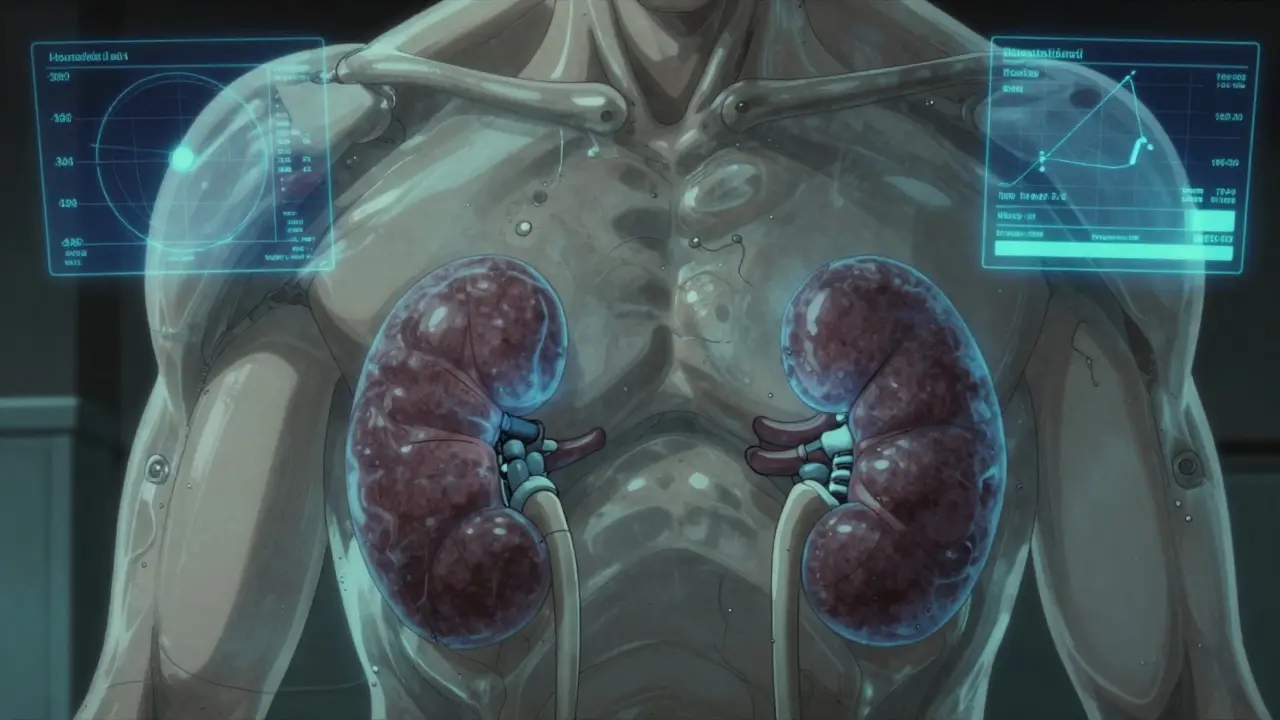
An adrenal incidentaloma is a lump in the adrenal gland that shows up by accident - usually during a CT or MRI scan done for something else, like a car accident, abdominal pain, or even a routine checkup. It’s not something you feel, and most people have no idea it’s there until a doctor points it out. These are surprisingly common. About 1 in 50 adults has one, and that number jumps to more than 1 in 14 for people over 70. The real question isn’t whether you have one - it’s whether it’s dangerous.
What Exactly Is an Adrenal Incidentaloma?
The adrenal glands sit on top of each kidney. They make hormones that control your blood pressure, stress response, metabolism, and even your sex drive. An incidentaloma is just a mass found by imaging that wasn’t being looked for. Most are small, under 2 cm, and harmless. But not all. About 80% are benign, non-functioning adenomas - basically, harmless lumps that don’t make extra hormones. The other 20%? That’s where things get tricky. About 5-10% of these masses produce too much hormone. A few percent are cancerous. And missing one of those can be life-threatening.
Why Evaluation Matters - Even If You Feel Fine
You might think, "If I feel fine, why worry?" But here’s the catch: adrenal tumors don’t always cause symptoms until they’re dangerous. A pheochromocytoma - a rare tumor that makes too much adrenaline - can cause sudden, deadly spikes in blood pressure during surgery if not caught first. A cortisol-producing tumor can slowly raise your blood sugar, weaken your bones, and increase your risk of heart disease without you ever feeling sick. And adrenocortical carcinoma? It’s rare - only about 2% of incidentalomas - but it grows fast and spreads if not removed early.
That’s why every adrenal incidentaloma gets evaluated the same way: hormone tests first, then imaging. No exceptions.
The Three-Step Evaluation Process
The current standard - backed by the Endocrine Society and major medical centers - is a clear, step-by-step approach.
- Check for hormone overproduction. Every single case needs three tests: one for adrenaline-type hormones (metanephrines), one for cortisol, and one for aldosterone if you have high blood pressure or low potassium.
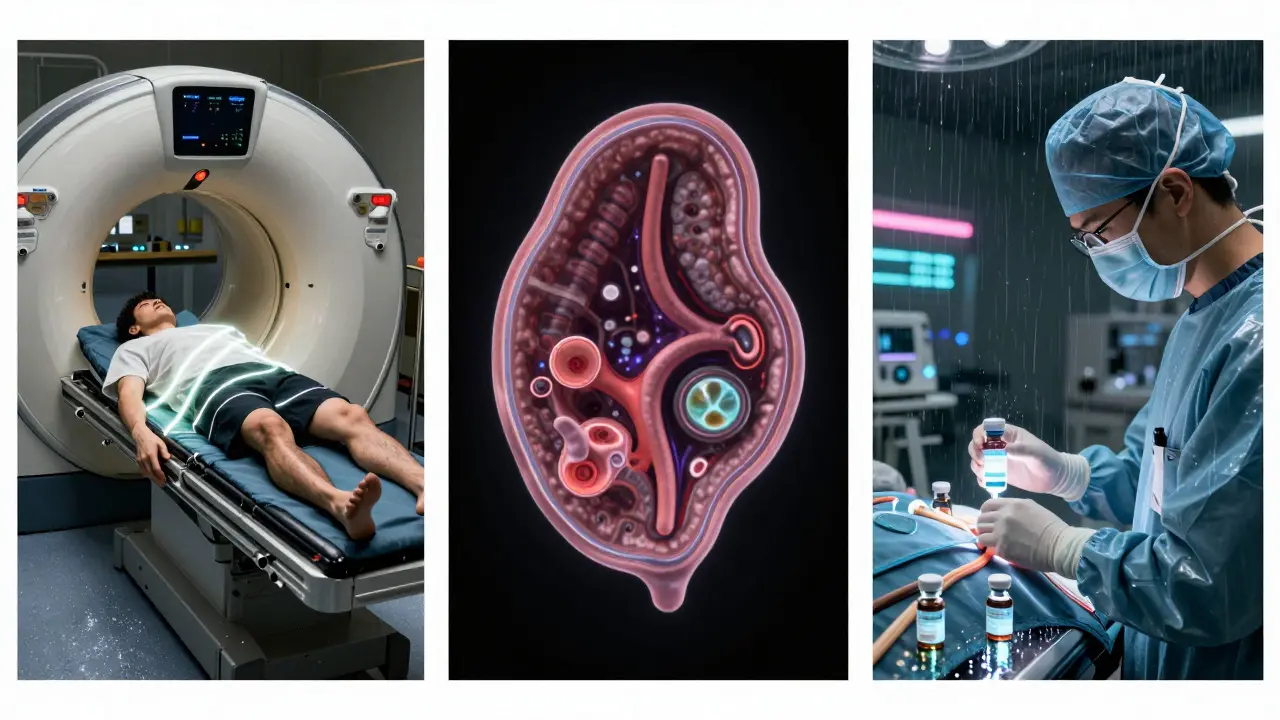
- Look at the scan. The first scan is usually an unenhanced CT. If the tumor has a density under 10 Hounsfield units, it’s almost certainly a benign adenoma - about 75% of the time. If it’s over 10, or if it looks irregular, has uneven texture, or is larger than 4 cm, you need more imaging - often an MRI or a specialized CT with contrast.
- Measure growth. If the mass is indeterminate, you get a repeat scan in 6 to 12 months. If it grows more than 1 cm in a year, or doubles in volume, that’s a red flag.
These aren’t suggestions - they’re the minimum required steps. Skipping any one of them increases risk.
When Surgery Is Necessary
Not every adrenal mass needs to come out. But some absolutely do. Here’s when surgery is recommended:
- Any tumor that makes hormones. That includes pheochromocytomas (adrenaline), cortisol-producing tumors (Cushing’s), or aldosterone-producing adenomas (Conn’s syndrome). Size doesn’t matter. If it’s making too much hormone, remove it.
- Tumors larger than 4 cm. The risk of cancer jumps sharply here. Tumors under 4 cm have less than a 1% chance of being cancer. At 4-6 cm, it’s about 5%. Over 6 cm? That’s a 25% risk. That’s why 4 cm is the cutoff for surgical consideration.
- Tumors with suspicious imaging. If the CT shows irregular edges, uneven texture, or signs of spreading to nearby tissue, surgery is the next step - even if the tumor is small.
- Rapid growth. If a mass grows more than 1 cm in a year, it’s treated like cancer until proven otherwise.
For pheochromocytomas, surgery isn’t just about removal - it’s about preparation. You need to be on alpha-blockers for at least 7 to 14 days before surgery. Skipping this step can cause a hypertensive crisis during anesthesia - which can be fatal.
What About Small, Non-Functioning Tumors?
If your tumor is under 4 cm, doesn’t make hormones, and looks smooth and even on the scan - you’re probably fine. No surgery. No follow-up scans. No medication. Just live your life. That’s what the guidelines say. Yet many patients and even some doctors get anxious and want to repeat scans every year. That’s unnecessary. It adds cost, radiation exposure, and stress - with zero benefit.
Only about 10-15% of cases are truly indeterminate. Those are the ones that need a repeat scan in 6-12 months. After that, if nothing changes, you’re done.
The Hidden Challenge: Subclinical Cushing’s
One of the hardest parts of managing adrenal incidentalomas is spotting subclinical Cushing’s syndrome - when the tumor makes just a little too much cortisol. You don’t have the classic symptoms like moon face or purple stretch marks. But you still have higher blood pressure, more belly fat, worse insulin resistance, and higher risk of heart attacks and strokes. Studies show these patients have worse long-term outcomes than those with normal hormone levels.
The standard test is the 1 mg dexamethasone suppression test. If your cortisol is above 1.8 μg/dL after the pill, it’s suspicious. New research from 2023 shows that testing urine for steroid metabolites - not just cortisol - is even more accurate. It catches 92% of cases, compared to 80% with the old test. This new method is starting to show up in top centers, but it’s not yet routine everywhere.
Who Should You See?
This isn’t a general practitioner issue. It’s a specialist problem. You need an endocrinologist who knows adrenal tumors, a radiologist who’s read hundreds of adrenal scans, and ideally, a surgeon who does adrenal operations regularly. Studies show patients treated at specialized adrenal centers are 92% satisfied with their care - compared to 68% at general hospitals.
The problem? Only 37 hospitals in the U.S. are officially designated as Comprehensive Adrenal Centers. Many community labs can’t even run the metanephrine test. In fact, only 45% of community hospitals have immediate access to it. That means delays, misdiagnoses, and missed diagnoses.
What’s Changing in 2026?
The Endocrine Society is updating its guidelines this year. The big shift? They’re moving toward more aggressive treatment for subclinical Cushing’s. If your post-dexamethasone cortisol is above 5.0 μg/dL - not just 1.8 - surgery is now strongly recommended. Why? Because new long-term data shows these patients have significantly better blood sugar control, lower blood pressure, and fewer heart events after removal.
Also, the 1 cm cutoff for calling something an incidentaloma is being questioned. Japan uses 2 cm. Some experts say smaller masses are rarely dangerous. But European and U.S. guidelines still hold at 1 cm. Until there’s consensus, err on the side of caution.
What Patients Say
Online forums are full of stories from people waiting for test results. One Reddit user wrote: "I went from feeling fine to terrified that I had cancer. I couldn’t sleep. The waiting was worse than the diagnosis." A survey of 142 patients found 78% felt extreme anxiety during the evaluation process. That’s real. And it’s why clear communication matters.
But those who got care at specialized centers report something different: "They explained everything. Told me what I needed to know - and what I didn’t. I felt in control." That’s the goal: clarity, not fear.
Final Takeaway
Adrenal incidentalomas are common. Most are harmless. But a few can kill you if ignored. The key is not to panic - but to act. Get the right tests. Know the thresholds. See the right specialists. And don’t let fear lead to unnecessary scans or surgery. The system isn’t perfect - but if you follow the evidence, you’ll avoid the biggest risks.
Are all adrenal incidentalomas cancerous?
No. About 80% of adrenal incidentalomas are benign, non-functioning adenomas - harmless lumps that don’t produce hormones or grow. Only about 2% are cancerous, and another 5-10% produce excess hormones. Most don’t need treatment.
What tests are needed for an adrenal incidentaloma?
Three key tests: plasma-free metanephrines or 24-hour urinary metanephrines to rule out pheochromocytoma, a 1 mg dexamethasone suppression test to check for cortisol excess, and plasma aldosterone and renin levels if you have high blood pressure or low potassium. Imaging starts with an unenhanced CT scan to measure density.
When should an adrenal tumor be removed?
Surgery is recommended if the tumor is larger than 4 cm, produces excess hormones (even if small), shows signs of cancer on imaging, or grows more than 1 cm per year. All functional tumors - whether pheochromocytoma, Cushing’s, or Conn’s syndrome - require removal regardless of size.
Do I need follow-up scans if my tumor is small and non-functioning?
No. If your tumor is under 4 cm, doesn’t make hormones, and looks smooth on the CT scan, no follow-up is needed. Repeated scans add radiation, cost, and anxiety without benefit. Only indeterminate cases - about 10-15% - need a repeat scan at 6-12 months.
Can adrenal incidentalomas cause symptoms later?
Yes - but only if they start producing hormones or grow into cancer. A benign, non-functioning tumor won’t suddenly become active. However, if it’s a cortisol-producing tumor, it may slowly cause weight gain, high blood pressure, or diabetes over time. That’s why initial testing is critical - not waiting for symptoms.

Natali Shevchenko
March 21, 2026 AT 11:58It’s wild how something as mundane as a CT scan for a car accident can reveal this whole other layer of your body you never knew about. I’ve always thought of our organs as quiet, obedient workers-until they’re not. Adrenal glands? They’re basically tiny hormone factories with a secret switch, and sometimes that switch gets stuck. The fact that 80% of these are just harmless lumps makes me wonder why we panic so much. We’ve turned medical imaging into a lottery ticket where you’re not sure if you won or lost until you’ve taken three tests, seen three specialists, and Googled every symptom under the sun. Maybe the real illness here is anxiety disguised as precaution.
And yet-I get it. If I found out I had a ticking time bomb in my body, even if the odds were 98% in my favor, I’d want to know. Not because I’m scared of cancer, but because I’m scared of not knowing. That’s the real trade-off: certainty versus overkill. We’re so obsessed with catching every edge case that we forget most people just need to live their lives without being turned into medical case studies.
Also, the part about subclinical Cushing’s? That’s the quiet killer. No moon face, no stretch marks, just slowly turning your metabolism into a rusted engine. It’s not dramatic. It doesn’t scream. And that’s why it slips through. We’re trained to look for fireworks, not smoldering embers.
It’s not about fear. It’s about listening to your body when it whispers… and not screaming at it when it’s silent.
Johny Prayogi
March 22, 2026 AT 20:53YES. Finally someone who gets it. 🙌 I had one of these and the whole process was pure chaos. My PCP sent me to a radiologist who said ‘oh yeah, looks benign’ then sent me to an endo who ordered 7 different blood tests and a follow-up MRI. I was like, ‘so… am I dying or not?’
Turns out? Nope. Just a chill little bump. No hormones. No growth. Just… there. Like a freckle on your kidney.
Stop overtesting. Stop overreacting. If it’s under 4cm and silent? Let it be. Your anxiety is way more dangerous than the tumor.
Nicole James
March 24, 2026 AT 08:28But… what if… they’re NOT just lumps? What if the ‘benign’ ones are just the tip of the iceberg? What if the system is hiding the truth? I’ve read studies-peer-reviewed, mind you-that suggest the 80% benign stat is inflated because labs only test for the ‘obvious’ hormones… but what about the hidden ones? The ones that don’t show up on standard panels? The ones that are triggered by EMFs? Or glyphosate? Or… the 5G towers? I’m not saying it’s a conspiracy-I’m saying the system doesn’t WANT you to know.
And don’t get me started on the dexamethasone test. That’s a synthetic steroid. You’re giving someone a hormone to test if they’re making too many hormones… but what if the test itself alters the outcome? What if the real answer is… don’t test at all? Just… live? Eat clean? Sleep? Breathe? Maybe the adrenal glands just need peace… not a CT scan.
…I’m not crazy. I’m just… awake.
And I’ve got the journal articles. And the YouTube videos. And the Reddit threads. And the PDFs. And the handwritten notes. And the…
…I’m sorry. I’m getting emotional. I just… I need someone to understand.
…Do you understand?
…Do you??
Nishan Basnet
March 24, 2026 AT 11:24As someone who grew up watching my mother navigate the labyrinth of Indian healthcare, I can say with certainty: the real crisis isn’t the adrenal tumor-it’s the gap between knowledge and access.
In the U.S., you’ve got specialists, protocols, cutting-edge metabolite panels. In rural India? Many hospitals can’t even run a basic cortisol test. I’ve seen patients wait six months for a referral, only to be told, ‘We don’t have the machine.’
This isn’t just about medical guidelines. It’s about equity. The 1 in 14 elderly Americans with incidentalomas? They’re getting the gold standard. The 1 in 14 elderly in Bihar? They’re getting silence.
Maybe the real breakthrough isn’t a new test-it’s a system that delivers the same clarity, no matter where you live. Because knowledge shouldn’t be a luxury. And fear shouldn’t be a privilege.
Desiree LaPointe
March 25, 2026 AT 05:22Oh, sweet summer child. You think the guidelines are there to help you? Please. The Endocrine Society gets funding from pharmaceutical companies that make adrenal drugs. The ‘4 cm cutoff’? That’s not science-it’s a billing threshold. If you’re under 4 cm, you don’t need surgery, so you don’t need to pay for it. If you’re over? Boom. $80K procedure. Hello, profit margin.
And don’t get me started on ‘subclinical Cushing’s.’ That’s just a fancy term for ‘we found a tumor and now we need to sell you a surgery you don’t need.’
I’ve seen patients on cortisol blockers for years after being told their tumor was ‘borderline.’ Meanwhile, their blood pressure dropped, their weight stabilized, and their doctors… kept billing.
Trust your body. Not the algorithm. Not the guidelines. Not the ‘experts.’
…and maybe, just maybe, stop Googling your symptoms at 3 a.m.
matthew runcie
March 25, 2026 AT 09:24Good post. Clear. Calm. No panic. I appreciate that.
shannon kozee
March 25, 2026 AT 11:21Just want to say: if your tumor is small, non-functioning, and smooth? You’re fine. No scans. No stress. Just live.
That’s it.
trudale hampton
March 26, 2026 AT 21:45My mom had one. They told her to wait. She waited. Five years later, still no change. She’s 78. Still hiking. Still baking pies. Still alive.
That’s the real outcome. Not the scan. Not the test. Just… time.
Let people live.
Shaun Wakashige
March 28, 2026 AT 18:43TL;DR: If it's small and quiet, leave it alone. 😴
Paul Cuccurullo
March 29, 2026 AT 20:18There is a quiet dignity in letting the body heal itself-when it can. The adrenal glands, those silent sentinels perched atop our kidneys, are not broken machines to be fixed, but delicate instruments of balance. To intervene without necessity is to impose our fear upon nature’s rhythm.
That we have the power to scan, to test, to cut… does not mean we must. Wisdom lies not in action, but in restraint.
Let the small, silent masses remain. Let the body speak. And if it speaks of danger? Then we listen. Not before.
There is grace in waiting. And in trust.